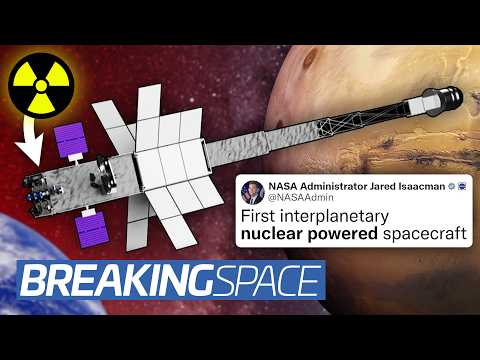
🚨 BREAKING - NASA ANNOUNCES NUCLEAR MARS MISSION IN 2028
NASA has revealed plans to launch the first nuclear-powered interplanetary spacecraft to Mars before the end of 2028; a major leap in deep space capability.
The mission, Space Reactor-1 (SR-1) Freedom, will:
⚡
Pesawat ruang angkasa antarplanet pertama yang didorong tenaga nuklir menuju Mars.
The U.S. National Aeronautics and Space Administration (NASA) has confirmed the launch schedule for the Space Reactor-1 Freedom (SR-1 Freedom) mission for December 2028, a milestone first announced in 2026. NASA Administrator Jared Isaacman underscored that this spacecraft will be the first interplanetary vehicle to operate using nuclear power beyond Earth orbit. This initiative forms the core of NASA's 'Ignition' strategy, which aims to accelerate United States capabilities in interstellar space, aligning with the mandate outlined in the National Space Policy.
Misi NASA berenergi nuklir ke Mars: SR-1 Freedom dijelaskan
The primary focus of the SR-1 Freedom mission is to demonstrate the effectiveness of nuclear-electric propulsion (NEP) technology in deep space. The NEP technology is crucial because it can provide efficient mass transport and high power in regions far beyond Jupiter, where conventional solar panels are no longer adequate. The craft will utilize an internal fission reactor to generate electricity, which then powers ion thrusters, a concept distinct from the nuclear thermal propulsion designs of the 1960s. To expedite development, NASA is repurposing propulsion and power elements (PPE) originally allocated for the currently suspended Lunar Gateway station.
SR-1 Freedom carries a significant scientific payload: three Ingenuity-class helicopters named 'Skyfall.' These aerial vehicles are scheduled for deployment on Mars to continue the exploration of the red planet, search for subsurface ice reserves, and assess potential landing sites for future crewed missions. The launch vehicle selected to carry SR-1 Freedom is the SpaceX Falcon Heavy rocket. The selection of the Falcon Heavy, capable of launching up to 16,800 kg to trans-Mars injection, reflects the partnership between the U.S. government and private industry.
The project carries a dual objective beyond mere technology demonstration; it seeks to build a flight heritage for nuclear hardware and establish the necessary regulatory precedent for such technology. This mission is specifically designed to activate a domestic industrial base to support future megawatt-class fission power systems, planned for lunar bases and faster Mars transits in the 2030s. While a one-way trip to Mars using traditional chemical propulsion takes at least six months, NEP is projected to reduce transit time to three to four months.
As part of its broader strategy, NASA has also redirected resources from the Lunar Gateway project to prioritize lunar surface infrastructure, targeting human landings beginning with Artemis IV in 2028, in response to global space exploration competition. Furthermore, NASA is currently soliciting student and research payloads for missions scheduled in 2027 and 2028. This effort, supported by a US$20 billion investment over the next seven years for a lunar base, signals NASA's renewed focus on not only reaching the Moon but establishing a sustained presence. Historically, the United States has invested over US$20 billion in space nuclear programs over six decades, yet only successfully flew one reactor, SNAP-10A in 1965, which never left orbit. The December 2028 launch of SR-1 Freedom, utilizing a nearly completed Power and Propulsion Element spacecraft bus, aims to conclude that pattern with a tangible mission and a firm deadline. This in-orbit NEP demonstration will serve as a crucial precursor to implementing Lunar Reactor-1 (LR-1), a surface fission power system for the lunar base.
During today's EVA, the crew will install a mod kit for the first of a pair of IROSA (Roll Out Solar Arrays), which will arrive later this year. Today's EVA will prepare the 2A power channel, with EVA 95 preparing the 3B channel.