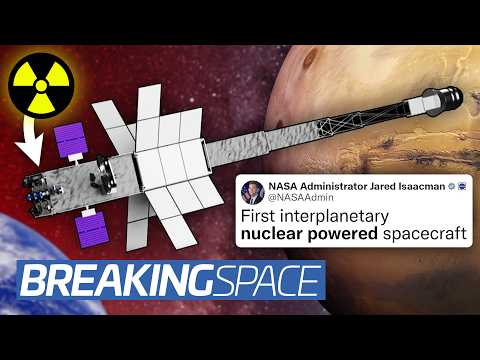
🚨 BREAKING - NASA ANNOUNCES NUCLEAR MARS MISSION IN 2028
NASA has revealed plans to launch the first nuclear-powered interplanetary spacecraft to Mars before the end of 2028; a major leap in deep space capability.
The mission, Space Reactor-1 (SR-1) Freedom, will:
⚡
The first nuclear-powered interplanetary spacecraft to Mars
NASA Administrator Jared Isaacman has confirmed the launch window for the Space Reactor-1 Freedom (SR-1 Freedom) mission for December 2028, adhering to earlier strategic timelines. This mission is designated to be the first operational spacecraft to employ nuclear fission power for propulsion beyond Earth's gravitational influence, representing a significant shift from conventional propulsion methods.
NASA’s Nuclear-Powered Mars Mission: SR-1 Freedom Explained
The SR-1 Freedom initiative is positioned as a core element of NASA's 'Ignition' strategy, designed to rapidly advance United States deep space capabilities in direct support of the National Space Policy. The primary technological goal is the in-space validation of advanced Nuclear Electric Propulsion (NEP) systems for deep space transit. This technology is critical for achieving high-efficiency mass transport and providing substantial power reserves in regions past Jupiter, where solar arrays diminish in effectiveness due to solar distance.
The spacecraft will utilize an onboard fission reactor to generate electricity to power its high-efficiency ion thrusters, a concept distinct from the nuclear thermal exploration of the 1960s. To accelerate development, NASA is repurposing hardware from the Power and Propulsion Element (PPE), originally developed for the now-suspended Lunar Gateway station, for the SR-1 Freedom. The reactor is engineered to produce approximately 25 kilowatts of continuous electrical power, offering a lower mass solution for more power compared to solar electric systems.
The activation of the fission reactor is scheduled within 48 hours of escaping Earth's gravity, marking a key milestone in re-establishing American space nuclear capability after a multi-decade gap. The mission also carries a scientific payload: three Ingenuity-class rotorcraft named 'Skyfall,' intended for deployment near Mars to further exploration of the planet. These next-generation autonomous helicopters will be deployed mid-air, a new operational concept, and will carry instruments such as ground-penetrating radar to survey potential human landing sites and characterize subsurface water ice.
The launch vehicle selected for the SR-1 Freedom project is the SpaceX Falcon Heavy rocket, a partially reusable, heavy-lift system capable of generating over 5 million pounds of thrust at liftoff. The overarching objectives for the mission extend beyond immediate exploration; it is intended to establish flight heritage for space-based nuclear hardware and create necessary regulatory precedent for this emerging technology. Furthermore, the mission aims to stimulate the domestic industrial base for future megawatt-class fission power systems, which are integral to projected lunar bases and accelerated crewed Mars journeys in the 2030s.
During today's EVA, the crew will install a mod kit for the first of a pair of IROSA (Roll Out Solar Arrays), which will arrive later this year. Today's EVA will prepare the 2A power channel, with EVA 95 preparing the 3B channel.