


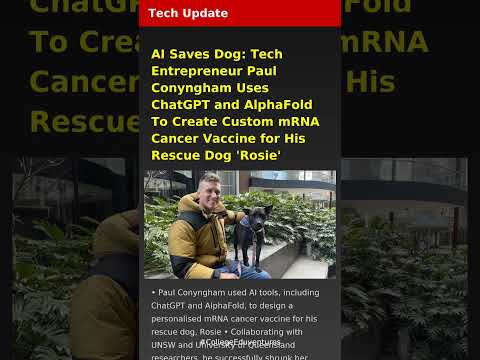
Paul Conyngham, an Australian IT entrepreneur with deep expertise in machine learning, has pioneered an experimental oncology treatment for his dog, Rosie, following a series of malignant diagnoses. Rosie, a mixed-breed Staffordshire Terrier and Shar-Pei adopted from a shelter in 2019, was diagnosed in 2024 with an aggressive mast cell tumor, which is the most prevalent form of skin cancer in canines. While standard medical interventions such as surgery and chemotherapy were attempted, they only managed to slow the progression without shrinking the tumors, leaving veterinarians to predict that Rosie had only one to six months of life remaining.
Faced with this terminal prognosis, Conyngham, the co-founder of Core Intelligence Technologies, applied his analytical background to the problem, treating the medical crisis as a data processing challenge. He began a rigorous process that involved sequencing the tumor's DNA at a cost of approximately $3,000, comparing the results with healthy cell DNA to identify unique cancerous mutations. To interpret this complex genetic information, Conyngham turned to artificial intelligence tools, specifically using ChatGPT as a research aide and Google DeepMind’s AlphaFold. ChatGPT assisted in structuring a strategic action plan that included exploring immunotherapy, eventually leading the entrepreneur to the Ramaciotti Centre for Genomics at the University of New South Wales (UNSW).
The AlphaFold system, designed to predict the three-dimensional structures of proteins, was used to model abnormal proteins, allowing for the precise identification of neoantigens that would serve as targets for a custom vaccine. The AI-generated data, consisting of specific mRNA sequences, was then handed over to scientists at the UNSW RNA Institute, led by Professor Pall Thordarson. These experts transformed the digital information into a physical mRNA construct, employing the same sophisticated technology used in the development of COVID-19 vaccines.
Professor Martin Smith, an associate professor of computational biology and director of the UNSW RNA Institute, noted that this case illustrates the potential for rapid and cost-effective development cycles for personalized mRNA vaccines, a growing field in oncology. Rosie received her first injection of the personalized medicine around Christmas 2025, following ethical approval for experimental veterinary immunotherapy. Within a month of starting the treatment, significant clinical improvements were observed: one tumor had halved in size, while another had been reduced by 75%. Rosie’s general condition improved markedly, accompanied by a visible increase in her energy levels.
Despite the success, scientists emphasize that this is a single case study and not a full-scale clinical trial, suggesting that broad implementation will take several years of further research. Notably, one of Rosie’s tumors did not react to the initial dose, which has led Conyngham and his team to initiate a second round of sequencing to understand the resistance and develop a subsequent iteration of the therapy. Nevertheless, this precedent—where a specialist without a formal biological background used AI to bring a medical concept to a functional treatment—offers a new perspective on the future of cancer treatment for humans.


