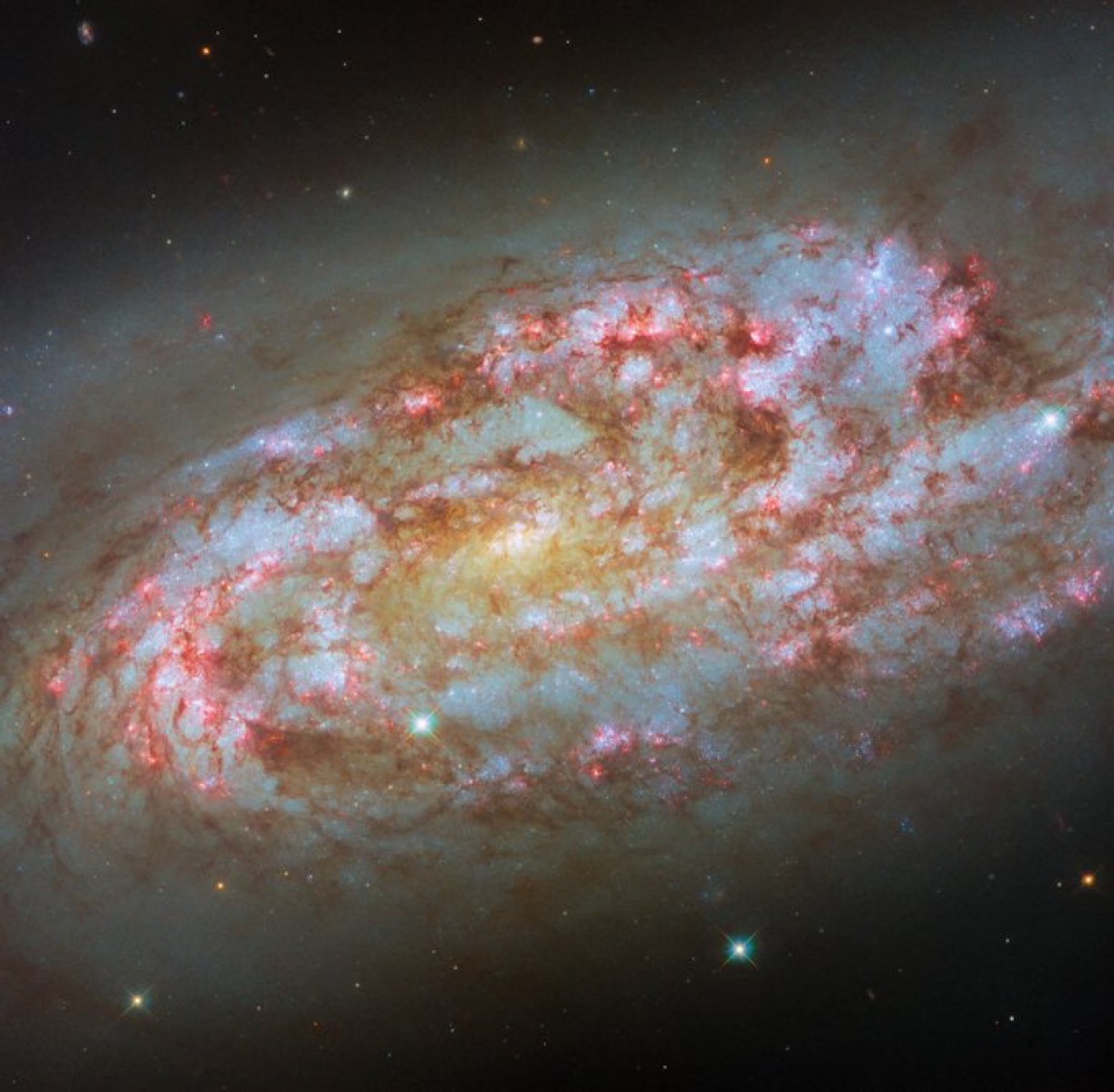
Spiral galaxy NGC 1792 with a burst of star formation. Source: ESA/Hubble & NASA, D. Thilker, F. Belfiore, J. Lee, and the PHANGS-HST team.
Share
Edited by: Uliana S.
Spiral galaxy NGC 1792 with a burst of star formation. Source: ESA/Hubble & NASA, D. Thilker, F. Belfiore, J. Lee, and the PHANGS-HST team.
The Hubble Space Telescope, a joint venture between NASA and the European Space Agency (ESA), has released a stunning, enhanced image of the spiral galaxy NGC 1792. This galaxy is notable for its intense rate of star formation. Located over 50 million light-years away from Earth, NGC 1792 resides within the southern constellation Columba. The European Space Agency made this new picture public in early December 2025, incorporating additional observational data gathered throughout 2025, which provides an unprecedentedly detailed look at the object's astrophysical processes.
NGC 1792 is classified as a starburst galaxy, meaning it is experiencing a period of exceptionally vigorous star birth. Its spiral arms are teeming with what astronomers call stellar nurseries. This high level of activity imbues the galaxy with significant luminosity relative to its overall mass, making it a prime target for detailed astronomical study. The characteristic red glows visible within the arms correspond to H-alpha emission. This emission is direct evidence of dense clouds of molecular hydrogen where new stars are actively being forged. Young, newly formed stars emit powerful ultraviolet radiation that ionizes the surrounding gas, resulting in this distinctive reddish hue.
A leading theory among astronomers suggests that the somewhat chaotic appearance of NGC 1792, and this surge in star formation, is a direct consequence of gravitational interactions with its larger neighbor, galaxy NGC 1808. It is hypothesized that the strong gravitational influence from NGC 1808 has agitated the gas reserves within NGC 1792. This agitation has effectively funneled the star formation process toward the side of NGC 1792 experiencing the greatest external tidal forces. Consequently, NGC 1792 serves as a crucial laboratory for understanding complex galactic encounters, including the dynamics of gas flows, the clustering of new stars, and the subsequent supernova events.
The updated visualization was captured using the Hubble’s Wide Field Camera 3 (WFC3). This instrument replaced the older Wide Field and Planetary Camera 2 (WFPC2) following the fourth servicing mission to the Hubble Space Telescope in May 2009. The WFC3 boasts a broad spectral sensitivity, capable of imaging wavelengths ranging from 200 to 1700 nanometers. The supplementary data acquired in 2025 significantly deepens our comprehension of the internal mechanisms driving this galaxy. Notably, NGC 1792 lacks the central bar structure seen in galaxies like our own Milky Way. This makes it an excellent case study for examining spiral morphologies that are being shaped by external forces, allowing research teams, such as the PHANGS-HST collaboration, to investigate how external pressures dictate internal structure and long-term evolution.
This galaxy, also cataloged as LEDA 16709, first entered the astronomical record books on October 4, 1826, cataloged by the Scottish astronomer James Dunlop. Between 1823 and 1826, Dunlop cataloged approximately 7,385 stars and numerous bright deep-sky objects while working from Parramatta, New South Wales, Australia. His most famous discovery remains the radio galaxy NGC 5128, better known as Centaurus A, which itself is another example of a starburst galaxy. This latest portrait of NGC 1792 powerfully underscores the role that gravitational perturbations play in igniting vigorous star formation in distant galactic systems.
El Heraldo de San Luis Potosi
Sci.News
NASA Science
Universe Space Tech
ORBITGEO.org
Noticias Ambientales
Did you find an error or inaccuracy?
We will consider your comments as soon as possible.