
ESA: a flaring black hole drives ultra-fast winds.
Astronomers Witness Super-Fast Winds Ejected by Supermassive Black Hole Following X-Ray Flare
Edited by: Uliana S.
In a remarkable celestial event observed toward the close of 2025, an international collaboration of astronomers documented a phenomenon where a hyper-velocity wind, propelled by a supermassive black hole, immediately succeeded a potent X-ray burst. This coordinated observation, utilizing several X-ray space telescopes, yielded crucial insights into the complex dynamics governing Active Galactic Nuclei (AGN). The findings of this study were formally presented in the December 2025 edition of the esteemed journal, Astronomy & Astrophysics.
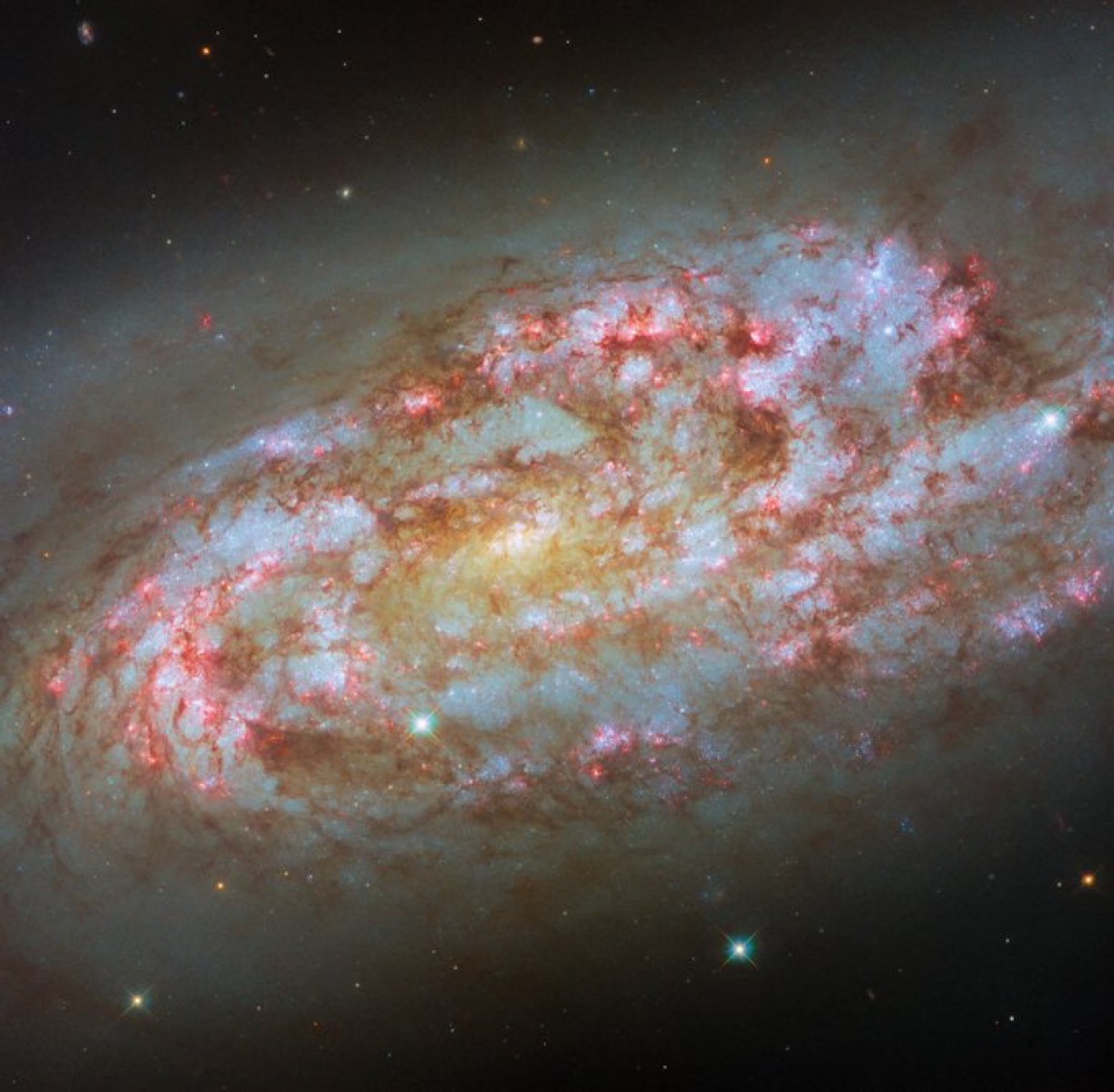
The focus of this intensive observation campaign was the supermassive black hole residing at the core of the spiral galaxy NGC 3783. This galaxy is situated approximately 130 million light-years from Earth. The central black hole possesses a mass equivalent to 30 million times that of our Sun. Its intense activity stems from the accretion of surrounding matter, which transforms the galactic nucleus into a brilliant emitter across the entire electromagnetic spectrum. Furthermore, data derived from reverberation mapping techniques estimate the mass of the black hole in NGC 3783 to be 2.8 million solar masses.
The observational data was gathered through the combined efforts of the European Space Agency’s XMM-Newton telescope, which was launched in December 1999, and the cutting-edge Japanese mission, XRISM, operational since September 2023. A detailed analysis revealed a sequence of events: first, a brilliant X-ray flare erupted from the black hole's core, which subsequently faded relatively quickly. Almost instantly afterward—within just one day—the object ejected material in the form of powerful winds. These winds were clocked at speeds reaching 60,000 kilometers per second, representing roughly one-fifth of the speed of light. Dr. Liyi Gu, the lead author of the research from the Netherlands Institute for Space Research (SRON), highlighted that the speed at which these winds materialized was unprecedented.
Co-author Dr. Matteo Guainazzi, affiliated with the European Space Agency (ESA), put forth a compelling hypothesis: these energetic outflows likely originated from a sudden “untangling” of a highly intricate magnetic field structure within the AGN. This physical mechanism bears a striking resemblance to the process that drives coronal mass ejections (CMEs) on our own Sun, albeit operating on an immensely grander scale. Dr. Erik Kuulkers, the project scientist for XMM-Newton, emphasized that this parallel strongly suggests the universality of fundamental high-energy physics principles throughout the cosmos.
Such high-speed outflows are fundamentally important for comprehending galactic evolution because they play a key role in what astronomers term the feedback process. The sheer energy transported by these streams can significantly influence star formation within the host galaxy. They achieve this by heating the interstellar gas, thereby regulating the pace at which the galaxy grows. The ability to capture this specific event was made possible by the simultaneous monitoring of NGC 3783 by a suite of seven space observatories, including NuSTAR, Hubble, Chandra, Swift, and NICER, showcasing a truly global astronomical effort.
3 Views
Sources
RTCG - Radio Televizija Crne Gore - Nacionalni javni servis
Discover Magazine
European Space Agency
ScienceDaily
Popular Science
Space.com
Anadolu Agency
SRON | Space Research Organisation Netherlands
Monthly Notices of the Royal Astronomical Society Letters
European Space Agency
Northwestern Now
Instituto de Astrofísica de Canarias (IAC)
Read more news on this topic:


Did you find an error or inaccuracy?
We will consider your comments as soon as possible.