
An illustration of GRB 250702B and the dusty galaxy from which it originated.
Astronomers Record Longest Gamma-Ray Burst Ever: GRB 250702B Hints at Intermediate-Mass Black Hole Event
Edited by: Uliana S.
The astronomical community has confirmed the detection of the longest-duration Gamma-Ray Burst (GRB) cataloged to date, designated GRB 250702B. This extraordinary event was first registered on July 2, 2025, by NASA's Fermi space telescope. The initial gamma-ray emission persisted for a minimum of seven hours, nearly doubling the previous record for cataloged GRBs. Furthermore, the phenomenon displayed recurring explosive pulses that extended its total active phase over several days, furnishing scientists with an unprecedented window for in-depth study.
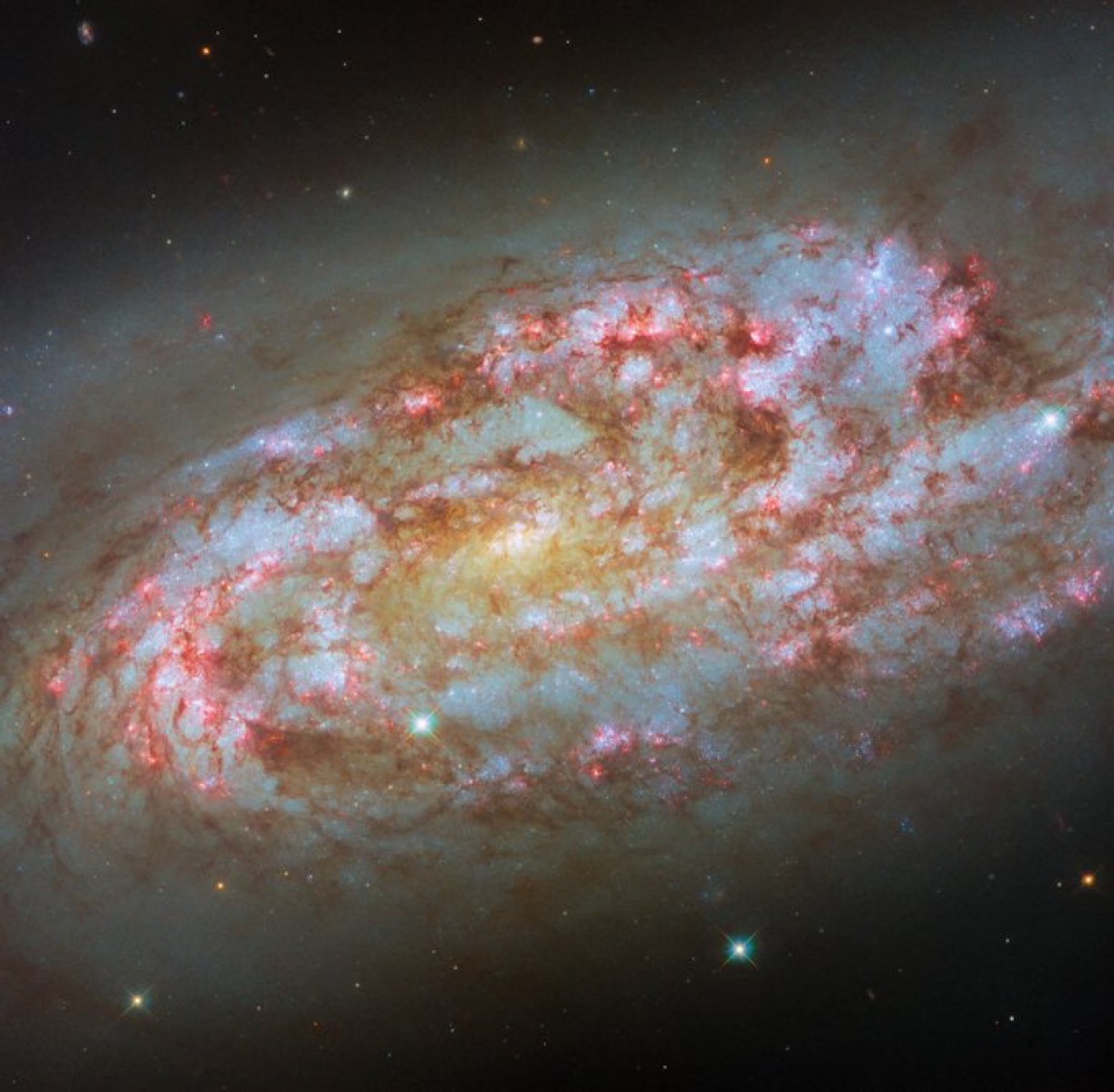
The star field around the host galaxy of GRB 250702B—the longest gamma-ray burst astronomers have ever observed.
The core significance of this cosmic occurrence lies in the registration of an anomalously protracted explosion that challenges conventional GRB models. It could represent the first direct observation of the tidal disruption of a star by an intermediate-mass black hole (IMBH), an object estimated to possess a mass between 100 and 100,000 times that of our Sun. The initial detection on July 2, 2025, immediately triggered a coordinated global response, mobilizing powerful ground-based observatories, including those managed by the European Southern Observatory (ESO) and the National Science Foundation (NSF).
The source of this signal originates from a distant, massive, and dust-rich galaxy located billions of light-years away from Earth. The detailed timeline reveals the initial seven-hour wave of gamma radiation, followed by subsequent, intermittent bursts over the ensuing days. This pattern is likely caused by a plasma jet, traveling at near light speed, interacting violently with dense surrounding gas and dust.
Key researchers involved in this analysis, such as Eliza Neitz from George Washington University and NASA's Goddard Space Flight Center, alongside Jonathan Carney from the University of North Carolina at Chapel Hill, are currently scrutinizing the vast datasets. Neitz noted that this burst bears no resemblance to anything observed in the last half-century, strongly suggesting a potentially novel mechanism for cosmic explosions. The sustained nature of the event provided an exceptional opportunity to observe the aftermath in real-time.
Collaborative efforts spanning numerous institutions were crucial. Instruments like ESO's Very Large Telescope (VLT), the NSF's 4-meter Victor M. Blanco Telescope, and telescopes from the International Gemini Observatory were instrumental in tracking the event for a full 18 days. The light from GRB 250702B began its journey toward us approximately 8 billion years ago. Subsequent observations utilizing the James Webb Space Telescope (JWST) and the Hubble Space Telescope revealed the radiation struggling to penetrate thick lanes of dust within the host galaxy.
Eric Burns from Louisiana State University emphasized that only the combined observational power of multiple space assets, including Swift and Psyche, allowed for a comprehensive understanding of this event. While standard explanations for GRBs typically involve the collapse of massive blue supergiants or Tidal Disruption Events (TDEs), GRB 250702B does not fit neatly into either established framework.
Among the alternative hypotheses being explored is a model involving the merger of a stellar-mass black hole with a helium star. However, researchers point out that such scenarios, alongside collapsars or micro-TDEs, fail to fully account for all observed characteristics. This underscores the sheer uniqueness of GRB 250702B within the context of the roughly 15,000 GRBs recorded since 1973. Should the tidal disruption scenario involving an intermediate-mass black hole be confirmed, this event will yield critically important empirical evidence regarding the existence of these 'middleweight' black holes.
5 Views
Sources
Space.com
NOIRLab
Space Daily
EurekAlert!
NASA
Read more news on this topic:


Did you find an error or inaccuracy?
We will consider your comments as soon as possible.