
Radiocarbon Dating Places Voynich Manuscript in Early Fifteenth Century Amid New Cipher Analysis
Edited by: Vera Mo
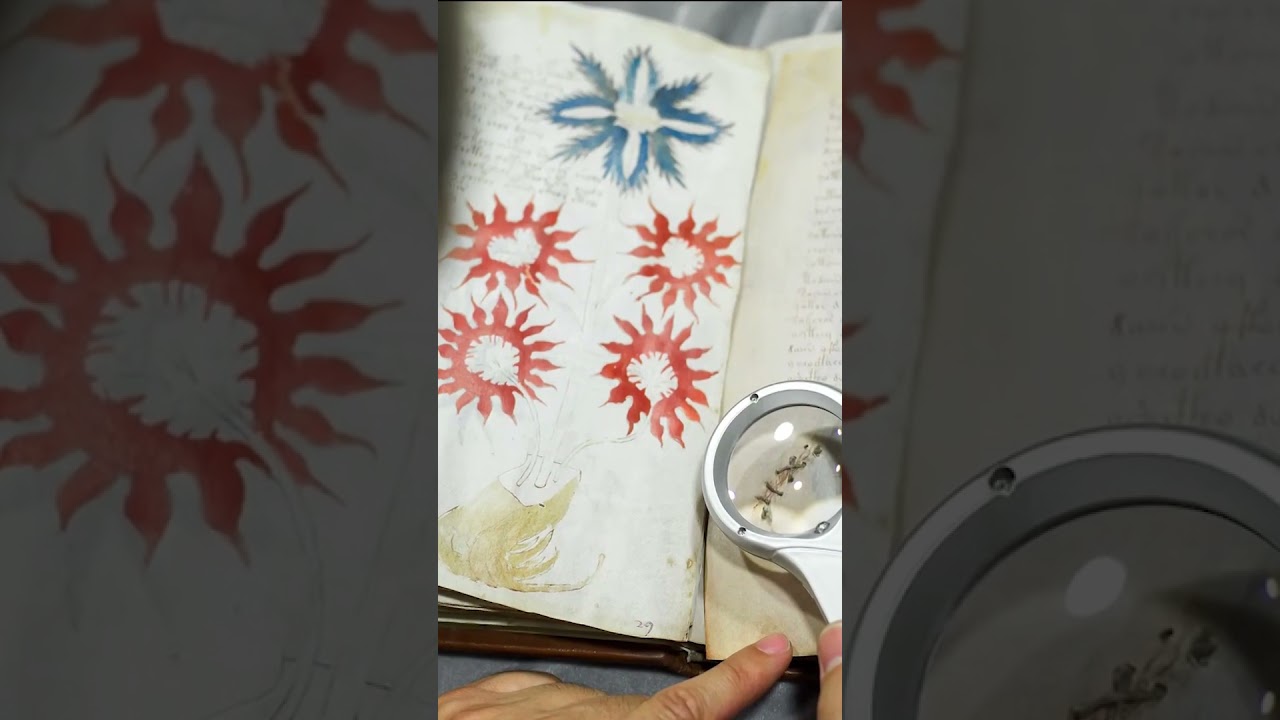
Radiocarbon analysis has precisely dated the Voynich Manuscript, an illustrated codex of historical obscurity, to the early fifteenth century, specifically between 1404 and 1438. The document, currently held at Yale University's Beinecke Rare Book and Manuscript Library, presents a significant cryptographic challenge due to its author and its undeciphered script, commonly referred to as Voynichese. The manuscript’s pages feature enigmatic drawings depicting human figures, astronomical symbols, and unidentified botanical specimens, which contribute to the textual puzzle’s visual complexity.
Recent analytical developments in 2025 have advanced the scholarly debate beyond mere speculation toward tangible encryption models. Journalist Michael Gresko published research in the journal Cryptologia detailing a novel algorithm he termed the "Naybe cipher." This system, developed while exploring mathematical commonplaces, transforms Latin or Italian text into a ciphertext that statistically mirrors the Voynich Manuscript’s characteristics. Gresko's method processes text sequentially, consolidating it into a stream, and then segmenting it into one- and two-letter blocks designated as "words," with the two-letter blocks receiving a syntactic prefix and suffix designation.
The modeling results from the Naybe cipher showed a high correlation with statistical anomalies observed within the manuscript. While Gresko does not claim this is definitive proof of the manuscript's origin, the method offers a reproducible system generating text with statistical profiles nearly identical to the original work. This research provides contemporary analysts with refined instruments for future investigation, thereby reactivating scholarly discourse regarding the book's purpose. Concurrently, other 2025 approaches are utilizing Artificial Intelligence to model linguistic shifts, suggesting the text may encode a structured, possibly mnemonic language.
Beyond these recent computational efforts, the manuscript's internal structure has undergone extensive statistical scrutiny over time, indicating it is unlikely to be random text. Paleography has identified five distinct individuals responsible for the handwriting throughout the document. Statistical analyses, including entropy calculations, show the text exhibits very low entropy per character compared to standard texts, a property that generally excludes simple substitution ciphers for many assumed source languages. The manuscript, which originally contained approximately 240 pages, features roughly 35,000 word-like groupings, including approximately 8,114 unique types.
Further complicating the manuscript's provenance, information emerged in 2025 regarding the "Voynich Key VX-2025." This asserted translation system claims to convert the manuscript's text into concise recipes and notes. Specific examples cited from this key suggest translations involving instructions for preparing herbal remedies, such as mixing crushed comfrey leaves with goat's milk or boiling meadowsweet buds in rainwater. This proposed key functions as a deterministic, rule-based system, maintaining strict consistency between glyph clusters and their translated meaning, yielding text resembling short herbal instructions in a mixed Latin-vernacular style characteristic of fourteenth- to fifteenth-century Tuscany or Lombardy.
Historically, the manuscript's context includes ownership by Emperor Rudolf II of Germany, who reportedly acquired it for 600 gold ducats, believing it to be the work of Roger Bacon. These new analytical tools, spanning Gresko's cipher model to the VX-2025 key, establish a critical, data-driven framework for understanding what may be a highly sophisticated, early Renaissance encryption of practical or esoteric knowledge.
7 Views
Sources
ТСН.ua
Lessons from History
Yale News
«Південна правда»
Фокус
Reddit
Read more news on this topic:


Did you find an error or inaccuracy?
We will consider your comments as soon as possible.