Record-breaking Antarctic drill reveals 23 million years of climate history phys.org/news/2026-02-a…

The drilling crew at work. Photo: Ана-Тови/SWAIS2C
Share
Edited by: Uliana Soloveva
Record-breaking Antarctic drill reveals 23 million years of climate history phys.org/news/2026-02-a…
The drilling crew at work. Photo: Ана-Тови/SWAIS2C
In January 2026, the international SWAIS2C (Sensitivity of the West Antarctic Ice Sheet to 2°C) project achieved a historic milestone at the Crary Ice Rise. Researchers successfully extracted a 228-meter-long sediment core, marking the longest sample ever retrieved from beneath the ice sheet. To reach these geological deposits, the team drilled through 523 meters of ice, uncovering a record that spans an estimated 23 million years. This archive includes eras when global temperatures significantly exceeded the modern 2°C warming target.
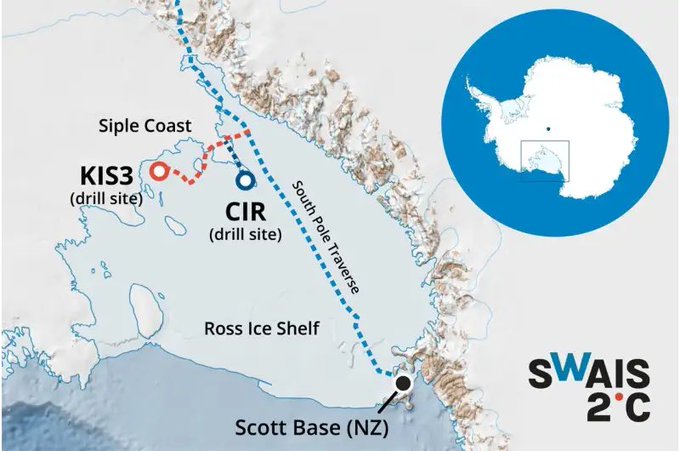
Map of the CIR and KIS3 drilling sites.
Situated approximately 700 kilometers from the nearest Antarctic hubs—the United States' McMurdo Station and New Zealand’s Scott Base—this geological repository offers vital data for forecasting the future stability of the West Antarctic Ice Sheet (WAIS). The SWAIS2C initiative represents a massive collaborative effort involving scientists from 10 nations: New Zealand, the United States, Germany, Australia, Italy, Japan, Spain, the Republic of Korea, the Netherlands, and the United Kingdom. Their primary objective is to determine how marine-based ice sheets react when global temperatures rise by 2°C.
The successful recovery of the 228-meter core, comprised of ancient mud and rock layers, followed two previous unsuccessful attempts during the 2024 and 2025 seasons due to significant technical hurdles. Initial examinations of the core have already revealed marine microfossils, providing evidence of past periods when this region was likely an open ocean rather than an ice-covered expanse. Understanding this sensitivity is paramount, as a total collapse of the West Antarctic Ice Sheet would trigger a global sea-level rise of four to five meters.
This multi-million-year dataset will allow climatologists to refine predictive models regarding the WAIS's response to warming beyond the 2°C threshold established by the Paris Agreement. Scientists are particularly focused on identifying layers from the Last Interglacial period, when temperatures were 1 to 1.5°C higher than pre-industrial levels. During that time, the WAIS's contribution to sea-level rise may have reached between 6 and 9 meters. The mission’s success, driven by a team of 29 specialists, proves that direct records of ice sheet behavior during past warm intervals can be obtained.
Professor Tina van de Flierdt of Imperial College London, a co-chief scientist of SWAIS2C, noted that this core provides the most comprehensive look yet at a future shaped by rising seas. Researchers, including co-chief scientist Huw Horgan from Victoria University of Wellington, emphasize that these insights are essential for developing global climate resilience policies. With approximately 680 million people living in vulnerable low-lying coastal regions, the data retrieved from the Crary Ice Rise is a critical component in the fight to protect at-risk populations worldwide.
CPG Click Petróleo e Gás
IFLScience
Guardian Liberty Voice
ETH Zürich
Earth Sciences New Zealand | GNS Science | Te Pū Ao
Imperial College London
IFLScience
informationsdienst wissenschaft
University of Exeter News
Imperial College London
EurekAlert!
The USAP Portal: Science and Support in Antarctica
University of Exeter News
SWAIS2C - Home
EurekAlert!
ResearchGate
Vostok, Antarctica bottomed out at −76.4°C (−105.5°F) sometime between 12:00 UTC yesterday and 00:00 this morning. 🇦🇶 If confirmed, this sets a new continental and worldwide record low temperature for March. 🌡️🏆 But you won't hear a peep about it in the press.

🇦🇶🇺🇦 The annual crew rotation at Vernadsky Station has been completed. The 31st Ukrainian Antarctic Expedition has fully commenced operations at the station, whilst the 30th UAE has set off for home. A long journey lies ahead for the polar explorers. First, r/v ‘Noosfera’, will


Microbes In Antarctica Survive The Freezing And Dark Winter By Living On Air #Microbes #Antarctica #Survive #Freezing #Dark #Winter #Living #Factory #Output #Production #Appliance #Equipment dlvr.it/TRW5Qw