
Observations show that several dusty objects, including a binary star system, maintain stable orbits near Sagittarius A*.
Stability Near Sagittarius A*: New VLT Data Challenges Tidal Disruption Theory
Edited by: Uliana S.
A recent scientific paper published in late 2025 has unveiled surprising observations concerning the supermassive black hole Sagittarius A* (Sgr A*) at the core of our Milky Way galaxy. An international research consortium, spearheaded by Dr. Florian Peissker of the University of Cologne, has determined that several so-called 'dusty objects' orbiting Sgr A* exhibit unexpected orbital resilience. This finding directly contradicts established theoretical frameworks regarding tidal forces in this extreme environment.
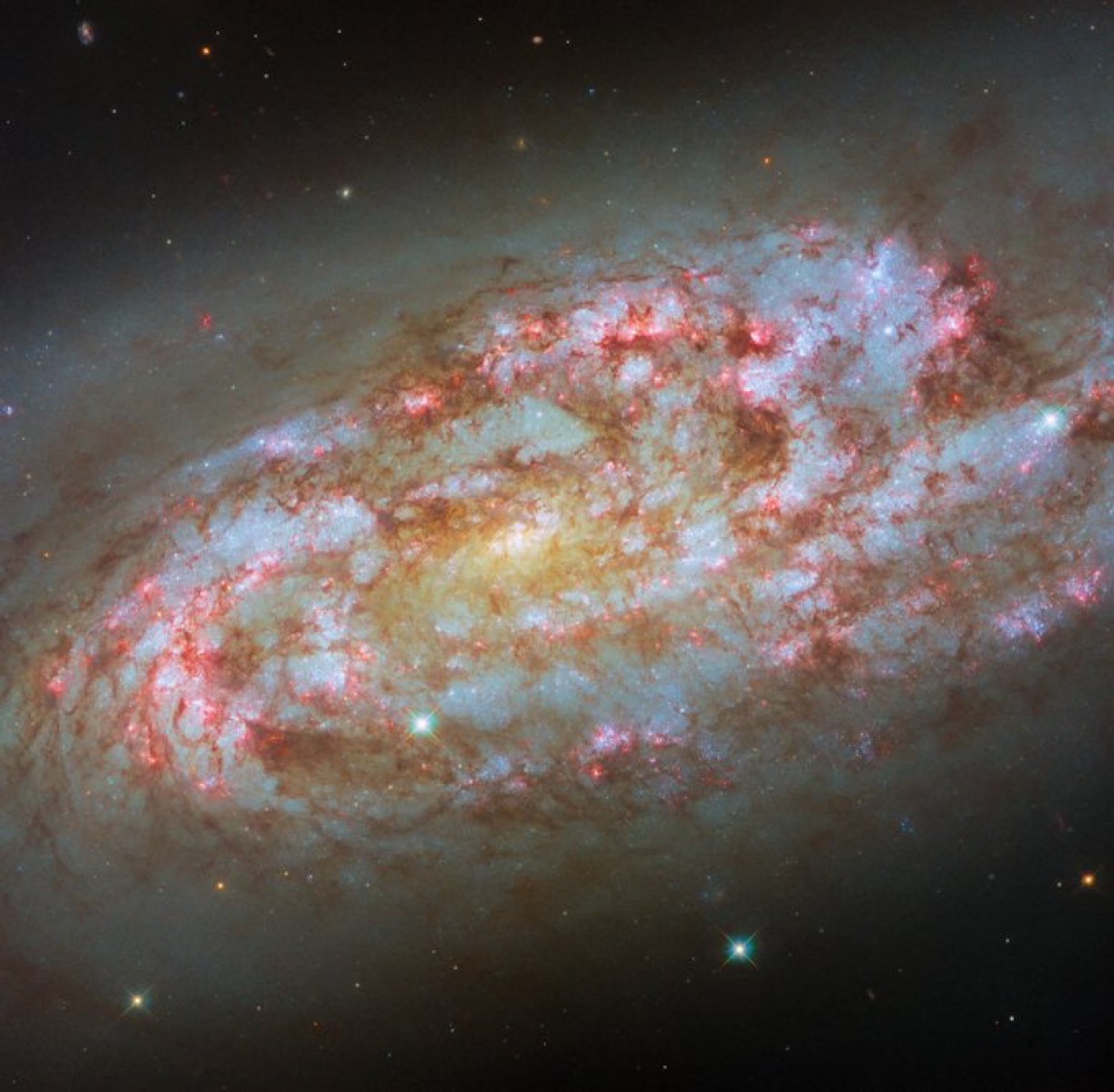
This image shows the location of the recently discovered binary star D9, orbiting around Sagittarius A*, the supermassive black hole at the center of our galaxy.
These groundbreaking results were achieved through the deployment of the new ERIS instrument—the Enhanced Resolution Imager and Spectrograph—mounted on the Very Large Telescope (VLT) located in Chile, operated by the European Southern Observatory (ESO). The data fundamentally question previous assumptions that these bodies were destined for immediate destruction via immense tidal stresses, a process often termed 'spaghettification.' The investigation focused critically on several key targets, including the object G2, the binary system D9, and the objects designated X3 and X7, all of which were widely expected to have already been torn apart.
The object G2, once characterized merely as a cloud of gas and dust on a collision course, is now shown by ERIS data to maintain a stable orbit. Researchers suggest this stability implies the presence of an embedded star within the cloud. Furthermore, the binary system D9, which Dr. Peissker's team first confirmed in 2024 as the first verified binary system orbiting so closely to Sgr A*, has also retained its structural integrity despite the intense gravitational shear. Object X7, historically observed to be highly elongated and predicted by older models to spiral into the black hole around 2036, is similarly demonstrating steady, predictable motion.
These empirical observations present a significant hurdle for astrophysical predictions concerning tidal disruption events near supermassive black holes. The sheer stability exhibited by the D9 system, in particular, suggests two major possibilities: either the local tidal forces are considerably weaker than current models estimate, or these orbiting bodies possess inherent internal mechanisms capable of successfully counteracting the extreme gravitational gradients. Dr. Peissker commented that the evidence points toward Sgr A* being less destructive in its immediate vicinity than previously calculated, suggesting that structure and stability can indeed persist in the galactic center.
The ERIS instrument, which gathers light in the near-infrared spectrum, represents the cutting edge of technology for the VLT, situated at the Paranal Observatory in Chile. It serves as an upgrade to previous instruments such as NACO and SINFONI. Concurrently, other research efforts, notably those utilizing data from the Event Horizon Telescope (EHT) in 2022, provided the first direct image of the accretion ring surrounding Sgr A*. Future investigations are anticipated to incorporate data from the forthcoming ESO Extremely Large Telescope (ELT) to further illuminate these perplexing orbital dynamics.
6 Views
Sources
ERR
Lifeboat Foundation
UCLA Division of Physical Sciences
YouTube
WION
Read more news on this topic:


Did you find an error or inaccuracy?
We will consider your comments as soon as possible.