



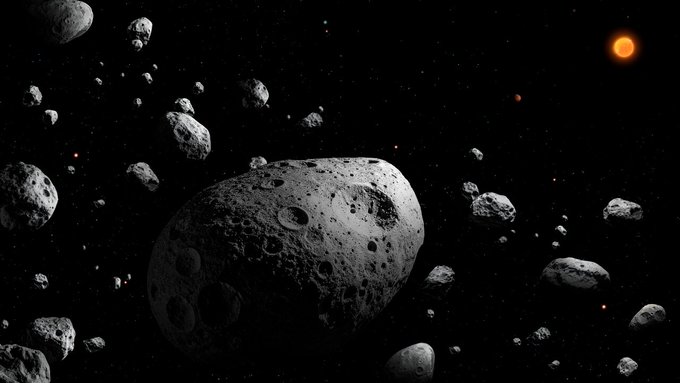
During the initial operational phase of the Vera C. Rubin Observatory, astronomers have documented a significant celestial event shedding light on the structural integrity of minor bodies within our Solar System. This discovery involves asteroid 2025 MN45, which is rotating faster than any previously cataloged object exceeding 500 meters in diameter. The finding, made possible by data from the National Science Foundation (NSF) and the U.S. Department of Energy’s (DOE) Legacy Survey of Space and Time (LSST) camera, was formally detailed in the first peer-reviewed scientific paper based on LSST camera data, published in The Astrophysical Journal Letters in January 2026.
Asteroid 2025 MN45, estimated to be about 710 meters across, completes a full rotation on its axis in a mere 1.88 minutes, translating to just 113 seconds. The data crucial for this analysis were gathered during the Rubin Observatory’s ‘First Look’ period, encompassing roughly ten hours of observation spread across seven nights in April and May of 2025. This performance underscores the exceptional capability of the LSST camera, the world’s largest digital camera, which is designed to capture images every 40 seconds, thereby validating the substantial investment made in this cutting-edge technology.
In addition to the headline discovery, the initial assessment team identified 19 other rapidly spinning asteroids larger than 90 meters in diameter. The majority of these newly characterized objects reside within the main asteroid belt. Among other notable finds in this batch are 2025 MJ71, which spins once every 1.9 minutes, and 2025 MK41, boasting a rotation period of 3.8 minutes. Leading this investigation was Dr. Sarah Greenstreet, an astronomer affiliated with the NSF’s National Optical-Infrared Astronomy Research Laboratory (NOIRLab) and an adjunct professor at the University of Washington.
Dr. Greenstreet emphasized that achieving such an extreme rotation rate for an object of this size necessitates extraordinary internal cohesion. Her calculations suggest that for 2025 MN45 to withstand the centrifugal forces generated by its rapid spin without breaking apart, its material must possess a cohesive strength comparable to solid rock, estimated at about 9 megapascals (MPa). This finding challenges the prevailing model that often characterizes most asteroids as fragile collections of rubble. Objects in the main asteroid belt exceeding 150 meters in diameter are generally expected to rotate slower than once every 2.2 hours to avoid disintegration due to centrifugal forces—a phenomenon known as the rotation barrier.
The existence of 2025 MN45 raises a fundamental question: how can such a substantial main-belt object spin so quickly without fragmenting? The fact that this asteroid significantly surpasses the established threshold strongly implies a monolithic structure. Researchers hypothesize that this high velocity could be the result of a powerful, relatively recent impact, or perhaps the object is a differentiated remnant from an earlier Solar System body. Aaron Rudman of SLAC National Accelerator Laboratory commented that this initial finding serves as a clear harbinger of the observatory’s main mission objectives.
The Vera C. Rubin Observatory, named in honor of the pioneering astronomer Vera Rubin, is slated for the official commencement of its 10-year Legacy Survey of Space and Time (LSST) in the first half of 2026. The LSST program will repeatedly scan the southern night sky over a decade, compiling an ultra-wide, ultra-high-definition time-lapse record of the cosmos. This capability not only confirms the observatory’s potential to uncover objects previously unimagined by scientists but also immediately yields invaluable data on asteroid physical properties, such as composition and evolutionary history, which were previously unattainable for such large main-belt bodies. Furthermore, 2025 MN45’s location in the main belt is considered unusual, as most previously observed fast-spinning objects have typically been near-Earth objects.


