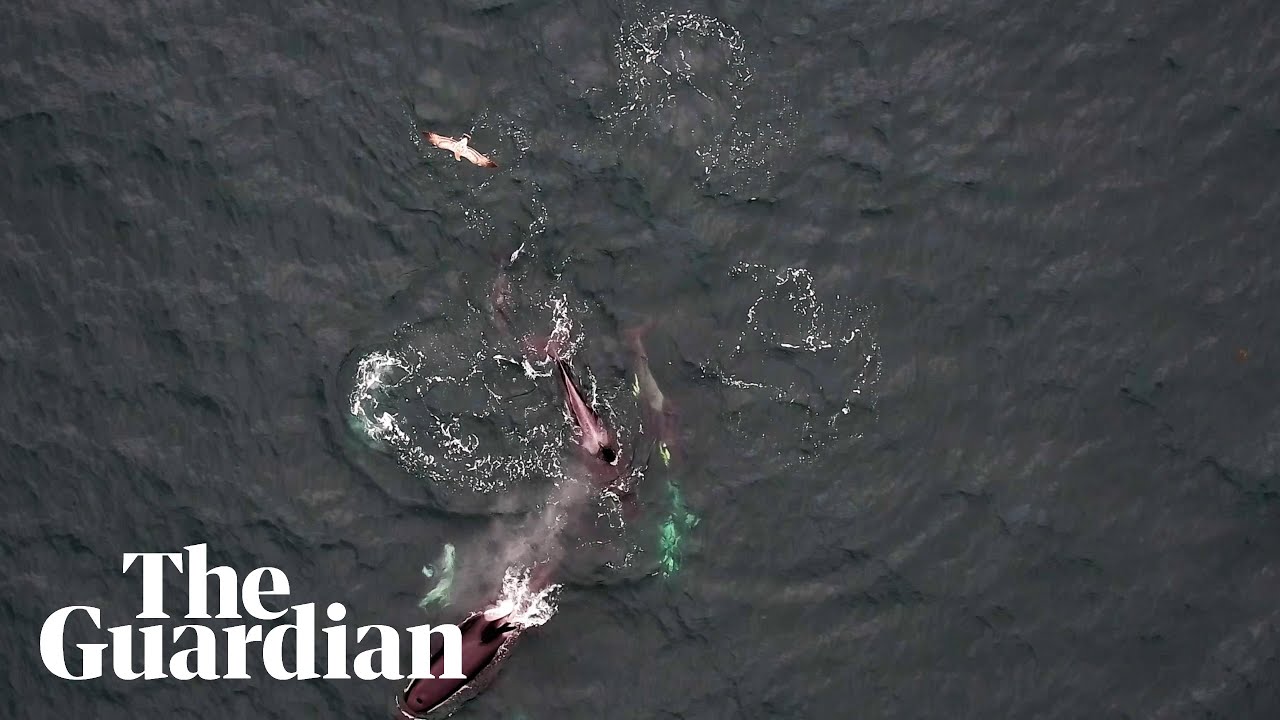
Whales and dolphins seen hunting together off British Columbia
Share
Edited by: Inna Horoshkina One
Whales and dolphins seen hunting together off British Columbia
Groundbreaking findings emerging from the waters off British Columbia suggest an unusual form of interspecies cooperation. Northern resident killer whales, Orcinus orca, which primarily target large salmon, appear to be utilizing Pacific white-sided dolphins as acoustic scouts. This research, detailed in the journal Scientific Reports, challenges the conventional view of predator competition, instead painting a picture of mutually beneficial partnership.
A collaborative team of scientists from the University of British Columbia (UBC), Dalhousie University, the Leibniz Institute, and the Hakai Institute documented instances where these orcas followed dolphins during foraging dives. Analysis revealed that the killer whales deliberately quieted their own echolocation, essentially eavesdropping on the clicks produced by the dolphins to pinpoint the location of Chinook salmon—their preferred prey. To gather this data, researchers employed drones and suction-cup bio-loggers, which recorded three-dimensional movement, acoustics, and dive profiles reaching depths exceeding 30 meters.
Fieldwork conducted during the summers of 2019 and 2020 in the Johnstone Strait and Queen Charlotte Strait areas recorded 258 separate episodes where white-sided dolphins were observed in close proximity to tagged orcas. The dolphins, which typically hunt smaller schooling fish like herring and are unable to swallow large salmon whole, actively pursued Chinook in these scenarios—fish that can grow nearly a meter long. The orcas gained a significant edge in locating deep-dwelling, substantial prey. Furthermore, in at least eight documented instances, the orcas shared the spoils: once the large fish was caught and torn apart at the surface, the dolphins immediately moved in to scavenge the scraps and scales.
Researchers speculate that the benefits for the dolphins extend beyond immediate caloric intake. White-sided dolphins are frequently preyed upon by mammal-eating transient killer whales that share the same habitat. In contrast, Northern residents generally steer clear of those predatory groups. Aligning themselves with fish-eating orcas may offer the dolphins added protection; observations showed zero aggression from the Northern residents toward the dolphins. This strongly supports the cooperation hypothesis rather than viewing the dolphins as mere pests stealing food.
On a purely instrumental level, this is a rare instance of interspecies cooperative foraging. However, looking at the bigger picture reveals deeper implications.
We observe several key takeaways:
Species often categorized as 'ruthless predators' are capable of forming subtle, counterintuitive alliances.
Sound functions here not just as a hunting tool, but as a medium of trust: one animal allows a neighbor to hear its search patterns while simultaneously adjusting its own behavior based on the neighbor's signals.
This collaboration arises not in spite of the wild, but as a natural adaptation to a complex, shifting environment.
If we consider the planet as a grand orchestra, this study adds a vital new line to the score: the ocean possesses the capacity not only to generate noise but also to listen, allowing disparate voices to amplify one another rather than create interference.
This echoes Mozart’s insight that music resides not in the notes themselves, but in the space between them—in how sounds relate, allow room for one another, and coalesce into a living, breathing structure. The orcas and dolphins remind us that the most crucial elements in the ocean happen not just in the clicks and calls, but in the moments one species chooses to quiet its own voice to hear another, thereby navigating the depths together more effectively.
At its core, echolocation relies on a beautiful, simple principle: sound originates from you, interacts with the environment—bodies, boundaries—and returns to you as actionable information about your surroundings and your own position within them.
A dolphin emits clicks, the wave bounces off fish, the seabed, or ice, and through that returning signal, it effectively 'sees' the world in darkness. We engage in a similar process using different waves.
Our own state is constantly broadcast outward:
How we speak,
The way we look at others,
The mood we carry into a room.
This acts as an impulse scanning the environment: people respond with words, gestures, or silence, and based on that feedback, we gauge where we are safe, which relationships feel close, and where we can breathe easily.
Simply put, echolocation is more than just sonar; it is how any living center tests the world for resonance. By interpreting the returning signal, it reaffirms its identity and place. The killer whales in this new study dampen their noise to hear the dolphins. We too can learn from this: sometimes, reducing our own internal clamor allows us to truly hear the world's response—and what 'frequency' returns to us when we express ourselves authentically.
The Guardian
The Guardian
CBC News
Live Science
UBC News
Discover Magazine
Did you find an error or inaccuracy?
We will consider your comments as soon as possible.