Rare underwater video of a mother humpback nursing her newborn
Share
Author: Inna Horoshkina One
Rare underwater video of a mother humpback nursing her newborn
Beneath the shimmering blue expanse of the Pacific Ocean, where sunlight fades from turquoise into the deep indigo, a silent ballet unfolds: a humpback whale mother and her newborn calf. In this vast, seemingly empty domain, their bond forms the warm, beating heart of the sea.
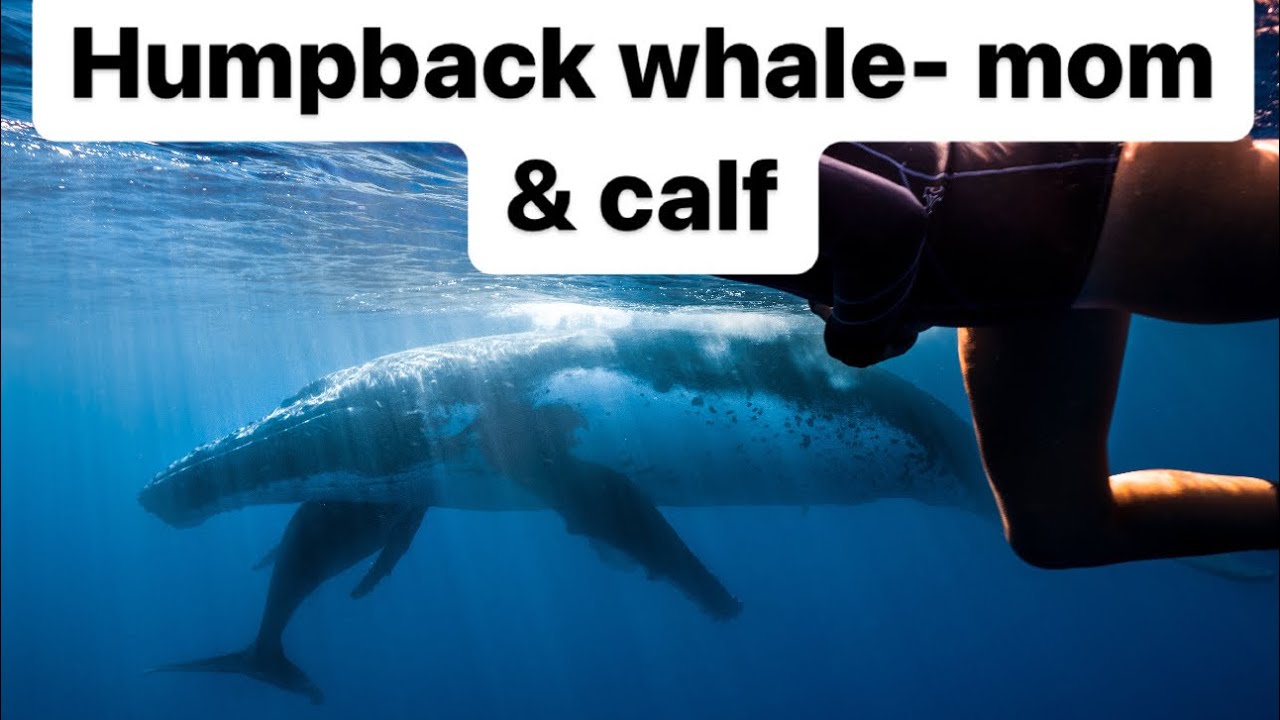
Humpback whale mom & calf
The calf stays close, tethered as if by an invisible string. Every movement the mother makes serves as a lesson: how to surface for air, how to descend into the depths, and how to interpret the subtle cues of the underwater environment. Yet, the most astonishing moments are those rarely witnessed by human eyes.
For most mammals, nursing is a terrestrial affair. For whales, however, the entire process is concealed beneath the waves. The mother uses a contraction of her powerful muscles to release a thick jet of milk.
This milk is a potent elixir of life, containing a staggering 40–50% fat. Its consistency is almost paste-like, and crucially, it does not immediately diffuse into the surrounding seawater. Instead, it forms a dense, nutritious cloud around the mother. The calf swims directly into this whitish stream, effectively 'grazing on the move,' ensuring not a single drop is lost to the ocean depths while remaining physically attached to its mother.
This remarkable feat of maternal engineering allows the calf to gain several dozen kilograms daily. During this intense period, the mother herself consumes almost nothing, relying entirely on fat reserves accumulated during previous migrations. Her entire body functions as a living reservoir of warmth and energy, wholly dedicated to this single offspring.
For a long time, scientific understanding suggested that the ocean soundscape was dominated by adults—the powerful songs of males or the calls between mothers and pods. Infants were largely assumed to be nearly silent participants.
However, research conducted between 2024 and 2025 has dramatically shifted this perspective. By utilizing acoustic tags—small recording devices affixed to the whales—biologists were finally able to isolate the vocalizations of the calves from those of the adults with precision.
The findings revealed several key points:
Calves are highly vocal and active even in feeding grounds.
The range of signal types they produce nearly matches that of adults, although their frequency of use differs.
Their sounds include a distinct 'babbling'—unformed vocal elements that bear a striking resemblance to the babbling stage of human infants.
In essence, the ocean's nursery has its own distinct language. Initially, these are soft, imperfect sounds, the first attempts to communicate with the world and with their mothers. These evolve into more recognizable signals: 'I am here,' 'Wait for me,' 'I am content,' or 'I am calling out.'
Further studies indicated that by the time a calf reaches about one year old, its voice deepens, its calls become longer, and its dives are more sustained and confident. The first year is not just about rapid physical growth; it is also about the formation of their sonic identity. The young whale learns to vocalize independently while remaining synchronized with the mother's voice and the ocean's rhythm.
When researchers correlated the sound recordings with video and behavioral data, a clear pattern emerged: the young produce different types of calls corresponding to distinct emotional or situational states.
Certain calls are used when searching for the mother or requesting food.
Others are emitted during periods of rest and quiet companionship.
A third set is used when distressed or actively calling out.
This is not random noise; it is an emotional lexicon where words are replaced by frequency, duration, timbre, and rhythm. These are, fundamentally, their 'milk requests' and their initial conversations with the ocean and their mother.
Against this backdrop, the common human metaphor that the 'ocean sings' becomes not just poetic but literally true: a genuine dialogue is taking place underwater.
For the scientific community, these investigations represent a significant step toward understanding how vocalization and language develop in these marine giants, and how the mother-offspring bond is forged in an environment where sound is paramount.
Perhaps the ocean is teaching us a lesson: to listen not just for meaning, but for intent—to perceive the vibration of care rather than just the text of the sound.
These findings add several simple yet profound layers to our perspective:
The ocean ceases to be mere background scenery. The term 'whales' now encompasses specific narratives of growth: milky clouds, nocturnal feedings, and infant murmurs in the deep.
Acoustic ecology transitions from an abstract concept to a matter of protecting the ocean's linguistic infancy. Vessel noise, seismic testing, and military exercises intrude not only upon the established songs of adults but also upon the delicate process by which the young learn to speak.
The parallel with human development is too clear to ignore. Just like our children, whale calves progress from tentative first sounds to a stable voice, and they require an equally safe 'sonic home.'
What have these discoveries contributed to the overall sound of our planet? The Earth is not just a collection of species; it is a multi-voiced choir of generations, where the voices of the young are as vital as those of the ancient.
We have the ancient voices of old-growth forests and elder whales. We have the mature, powerful 'words' of human civilization. And we have the quiet, still-forming voices of those just learning to exist—in the sea, the air, and on land.
To conserve the ocean for whales means preserving the space where children's voices can develop safely, becoming integrated into the planet's grand symphony. In this context, the thought of Johann Sebastian Bach resonates with simple, profound accuracy: 'The aim of music is to touch the heart.'
The sounds made by small humpback whales are music we are only beginning to reach with our instruments and concepts. Yet, they already touch the heart. This means we possess every reason to take the next step: to act as if the ocean's language is not a foreign sound beyond the horizon, but an integral part of our shared musical score.
When we do this, ocean stewardship ceases to be abstract 'ecology' and becomes what it has always been for the planet itself: the commitment to ensuring that this Earth continues to resonate with the voices of childhood—freely, joyfully, and in harmony.
Did you find an error or inaccuracy?
We will consider your comments as soon as possible.