


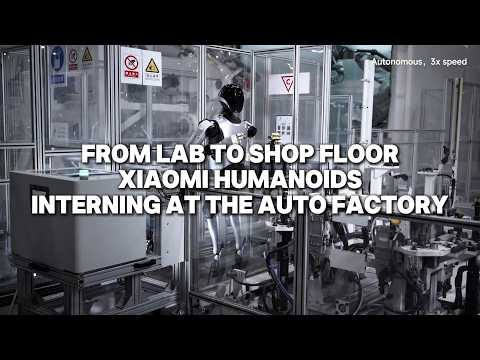
Chinese technology giant Xiaomi has introduced humanoid robots into the electric vehicle (EV) assembly line at its Beijing facility, marking a significant step in manufacturing automation. Xiaomi President Lu Weibing characterized the robots' initial role as that of "interns," emphasizing their capacity for continuous operation without the need for breaks, a focus on relentless operational efficiency.
The robots are currently undertaking specific assembly tasks, notably the crucial process of installing wheel nuts onto vehicle chassis at the highly automated production site. In an initial trial phase, two humanoid units successfully completed 90.2% of their assigned tasks over a three-hour period, a metric shared by Lu Weibing. Although initial observations suggested the robots might operate slower than human counterparts, Lu Weibing asserted their capability to match Xiaomi's demanding production rhythm, where a new vehicle is completed every 76 seconds.
This development is underpinned by Xiaomi's VLA (Vision-Language-Action) foundation model, named Xiaomi-Robotics-0, a system comprising 4.7 billion parameters enhanced with reinforcement learning technology. This advanced model integrates multi-modal inputs, including visual data, tactile feedback, and joint proprioception, which are essential for complex assembly actions like precise bolt handling and adaptation to minor variations on the production line. This integration lessens reliance on real teleoperation data, enabling quicker adaptation to diverse operational conditions.
Xiaomi’s move aligns with China's dual technological ambitions in EV dominance and advanced robotics automation. Industry analysts view the successful integration of humanoid robots into industrial production as a key model for addressing rising labor costs and aging workforces. CEO Lei Jun has articulated a five-year outlook, predicting that a substantial number of humanoid robots will be operational in Xiaomi factories, while maintaining their current "intern" classification.
This trend is mirrored across the industry; for instance, Xpeng has announced plans to establish mass production bases for humanoid robots by the end of 2026. Furthermore, BMW is reportedly scheduled to test humanoid robots at its Leipzig plant this coming summer, signaling an intensifying global automation race within the automotive sector. The successful execution of the wheel nut installation—a task complicated by the spline structure of the nuts and variable orientation—serves as a primary benchmark for overcoming core hurdles of production cycle time and yield rate before full-scale adoption can be justified.


