


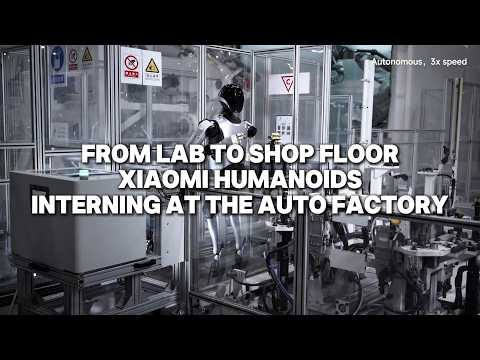
Chinese technology firm Xiaomi has begun integrating bipedal humanoid robots into its electric vehicle (EV) assembly operations at its Beijing factory, signaling a strategic move toward advanced automation in automotive manufacturing. Xiaomi President Lu Weibing referred to the initial group of robotic workers as 'interns,' noting their capacity to operate without scheduled breaks, which underscores the pursuit of continuous operational efficiency.
These advanced machines are currently assigned specific, high-precision assembly functions, including the crucial task of attaching lug nuts to the vehicle chassis. This deployment aligns with China's national technological objectives focused on utilizing artificial intelligence and robotics to enhance industrial output. During a three-hour trial, two of the humanoid robots successfully completed 90.2% of their assigned workload, a metric shared by Lu Weibing in an interview with CNBC.
While initial observations indicated the robots operated at a slower pace than human workers, Lu Weibing maintained their ability to sustain the production line's demanding rhythm. The Beijing facility is designed for high throughput, with a new vehicle completing the line approximately every 76 seconds. The robots are reportedly meeting the benchmark for seamless coordination between human labor and automated systems in their supervised roles.
The technology is powered by the Vision-Language-Action (VLA) large model, specifically Xiaomi-Robotics-0, which processes multimodal inputs including visual data, tactile feedback, and joint proprioception for improved environmental awareness and action execution. A key technical milestone involved the installation of self-piercing nuts, a task complicated by the nuts' spline structure and magnetic interference. The 90.2% success rate suggests the technology is in an early, learning phase, consistent with the 'intern' analogy.
Xiaomi leadership frames this deployment as a learning phase, with CEO Lei Jun projecting that a significant number of humanoid robots will be operational across Xiaomi's factories within the next five years, indicating a long-term commitment to scaling this technology. Industry analysis views this integration as a significant demonstration of how advanced robotics can alter manufacturing economics amidst rising labor costs. This development occurs within an intensifying competitive landscape, as rivals such as Tesla and Xpeng are also heavily investing in humanoid robotics for industrial applications.
Xiaomi's commitment to this area reflects its strategic evolution into a diversified technology conglomerate with substantial interests in electric vehicles and advanced automation. The company has previously committed over 100 billion yuan to research and development over the past five years and plans an additional 200 billion yuan investment over the next five years for 'hard tech' advancement. The integration into the highly automated Beijing EV plant, which already employs over 700 industrial robots, reinforces a strategy to use intelligence-driven operations to establish new global benchmarks for automotive production quality and speed.


