


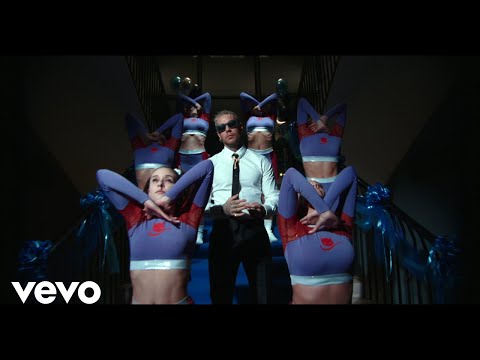
Emis Killa - Demons (Official Video)
Share
Edited by: Inna Horoshkina One
Emis Killa - Demons (Official Video)
On Friday, December 12, 2025, the usual sounds within the San Quirico prison in Monza were momentarily replaced by something entirely different for over an hour. The typical echoes of footsteps, roll calls, and commands gave way to beats, personal narratives, and the rare, profound silence where individuals truly listen to one another.
The Free For Music project, spearheaded by Orangle Records and guided by the socio-educational direction of Paolo Piffer, was conceived with a purpose far exceeding simple reporting. Its ambitious goal is to harness music as a vehicle for self-reflection and re-evaluation—not as mere background noise, but as a reflective mirror. This time, artists Fedez and Emis Killa joined the inmates to look into that mirror.
Roughly 80 incarcerated individuals gathered at San Quirico. The format was intentionally straightforward, which amplified its impact:
Emis Killa, who has prior experience with the project and clearly holds it close to heart, brought the current atmosphere of his latest work. His album “Musica Triste,” released on December 5, 2025, features fifteen tracks that represent the essence of hip-hop, delivered with a sharp, biting lyricism that makes no pretense about pain.
For a smaller group of twenty participants, he played the new tracks as a kind of litmus test: to see if their own stories could resonate with those who also live within four walls.
The central theme of the meeting was deeply paradoxical: finding freedom precisely where it seems entirely absent.
Emis Killa articulated a key insight: genuine freedom begins when one stops chasing the abstract ideal of it—the endless pursuit of being “richer, more famous, stronger.”
Fedez drew upon his own profound experiences, detailed extensively in his third book, “L'acqua è più profonda di come sembra da sopra”—covering illness, fear, oncology, and public scrutiny. He spoke about a different kind of cage: the internal one. He emphasized that self-expression serves as a way to push back the internal bars, even if the physical ones remain outside.
In this dialogue, rap transcended its common label as mere “street music.” It reverted to its origins: the language of those who have nothing left to hold onto the truth with except their words and rhythm.
In the digital age, any lyric can quickly become a rallying cry. Algorithms amplify everything—both honesty and toxicity.
Fedez and Emis Killa did not shy away from this reality. They openly acknowledged:
This was not a lecture on morality, but an honest admission: when millions are listening, every personal declaration of “this is how I live” can be interpreted by someone else as “this is how one should live.”
The most powerful segment began when the roles reversed. The inmates presented their own tracks, crafted during the Free For Music workshop. These were not just token amateur attempts; they were authentic narratives—sometimes rough around the edges, sometimes raw, but undeniably alive.
This was the moment such projects are truly worth undertaking:
Music functioned here not as entertainment, but as a rehearsal for societal reintegration: leaving prison requires more than serving time; it demands rediscovering that one’s voice still has value to others.
At the conclusion of their visit, Fedez and Emis Killa offered more than just appreciative words.
They committed to:
It is also noteworthy that this was not their first appearance; Lazza had previously visited Monza. This signals the development of a sustained line of work, where art serves as a tool for gentle systemic correction rather than mere window dressing.
On the surface, this is simply news about a prison initiative, a new album, a new book, and a social project. But listening closer reveals a deeper message:
Perhaps the most significant aspect of this event is not that famous artists visited a prison. The true takeaway is that for over an hour, the labels of “inmate” and “star” dissolved. What remained were simply people trying to articulate their continued existence to the beat.
In the grand symphony of the world, this day in Monza rings out as a quiet yet vital chord: as long as we can bring music to places seemingly devoid of light, we retain the chance to see the path ahead in a person, rather than just their sentence.
There are no mistakes, only experiences—sometimes heavy, sometimes fragile, but always unique to the person who lives them. This may be the living essence of “Judge not, that you be not judged”: we never truly know which string another person is attempting to tune within themselves.
Music does not erase the past, but it gently retunes us internally—shifting from defense to honesty, from internal warfare to seeking rhythm. In the moment eighty people in the room and two on the stage truly listen to each other, the most important realization becomes faintly audible: we are all distinct stories written into the same melody of Earth.
Prima Monza
Media Key
vertexaisearch.cloud.google.com
vertexaisearch.cloud.google.com
Il Messaggero
ilLibraio.it


