


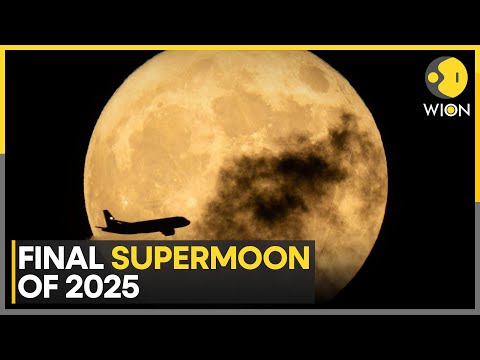
December Cold Supermoon Marks Final Lunar Spectacle of 2025
Edited by: Tetiana Martynovska
The final full supermoon of 2025, traditionally known as the Cold Moon, reached its peak illumination on Thursday, December 4, at 6:14 p.m. EST. This celestial event was classified as a supermoon because the Moon was near perigee, its closest orbital point to Earth, making it appear up to 14% larger and significantly brighter than an average full moon. This occurrence concluded a series of three consecutive supermoons, following the Harvest Supermoon in October and the Beaver Supermoon in November.
The timing of the Cold Moon near the December 21 winter solstice in the Northern Hemisphere afforded it a distinct visual characteristic: it achieved the highest arc in the night sky observed throughout the year. This elevated trajectory results from the Earth's axial tilt; as the Sun reaches its lowest point, the full moon, positioned opposite the Sun, attains maximum altitude. Astronomical data confirmed the proximity, placing the Moon approximately 222,000 miles from Earth on December 4, 2025, compared to a standard full moon distance of about 240,000 miles. This closeness, occurring only about 12 hours after perigee, officially designated it a perigean full moon.
While the precise moment of fullness occurred during daylight for much of North America, the Moon remained visually full across the evenings of December 3, 4, and 5. Observers noted that the Moon's ascent aligned closely with local sunset, an effect that amplified its perceived size near the horizon due to the 'Moon illusion.' The traditional name, Cold Moon, originates from Indigenous North American traditions, such as the Mohawk, reflecting the onset of frigid temperatures and deep winter. The Mohican people referred to it as the Long Night Moon, emphasizing its appearance during the year's longest nights near the solstice.
This final supermoon of 2025 was observed near the planet Jupiter, as well as bright stars like Aldebaran and Capella within the constellation Taurus. The event also preceded the peak of the Geminid meteor shower, scheduled for December 13–14, providing a subsequent opportunity for dark-sky viewing. The Beaver Supermoon on November 5, 2025, was noted as the closest supermoon of that year, with the December Cold Moon being the second-largest. The sequence of supermoons for this period is set to conclude with the Wolf Moon Supermoon in January 2026, with the next significant lunar event scheduled for January 3, 2026.
34 Views
Sources
WTOP
Alfavita
En Son Haber
The Old Farmer's Almanac
Forbes
The Washington Post
Astronomy Magazine
Live Science
Proson.gr
Το Κουτί της Πανδώρας
ScienceAlert
Logotypos.gr
Star Walk
Ensonhaber
Anadolu Ajansı
T24
Sabah
Bustle
Read more articles on this topic:


Spring is expected to officially arrive in Japan this week with the start of the #CherryBlossom season. According to the Japanese Meteorological Agency the blooms will arrive earlier this year because of a warmer than average winter. 🌸🌸🌸

Did you find an error or inaccuracy?We will consider your comments as soon as possible.