


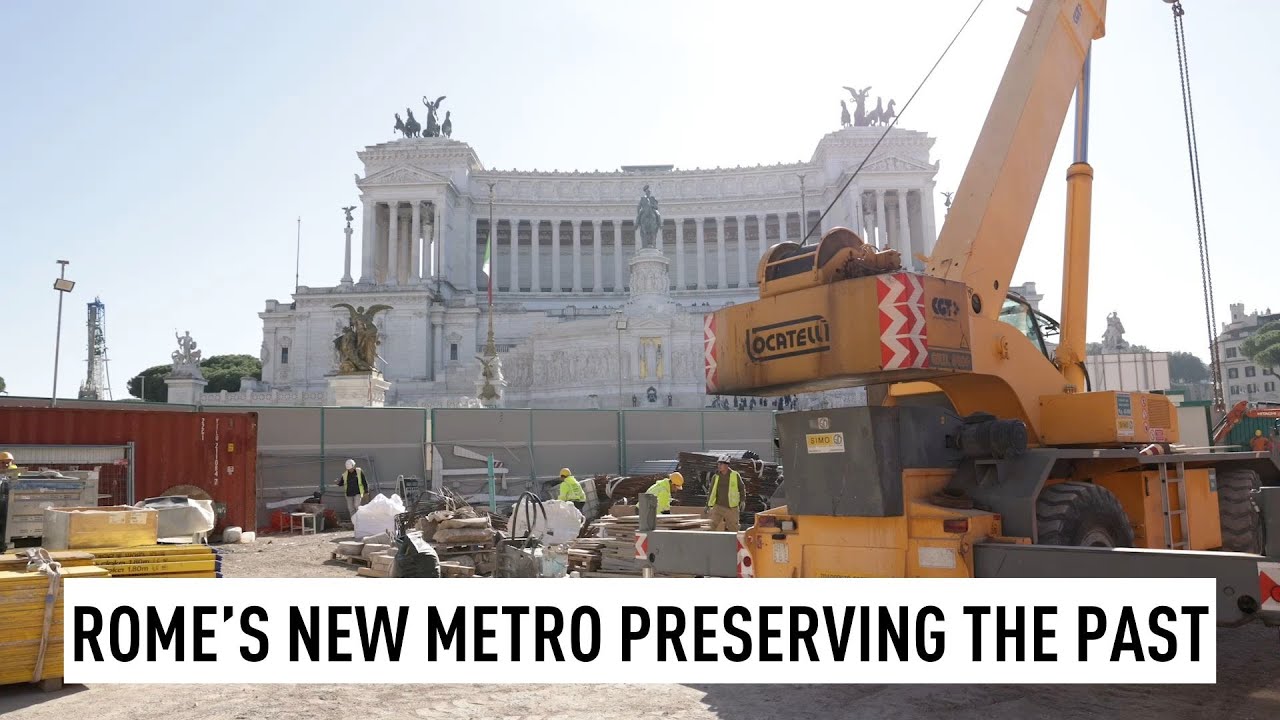
Rome's new Metro line showcases its deep past in 'museum stations'
Share
Edited by: Tetiana Martynovska 17
Rome's new Metro line showcases its deep past in 'museum stations'
Engineers and archaeologists collaborating on Rome's Metro C line are establishing unique "museum stations," scheduled for inauguration in 2025, which will integrate significant archaeological discoveries directly into the modern transit infrastructure. This initiative redefines public transportation hubs by transforming them into immersive exhibits that allow daily commuters to traverse the city's deep historical strata. The integration of ancient findings into contemporary mobility solutions signals a substantial commitment to preserving Rome's layered past while advancing urban development.
🚇 Metro C al Colosseo – conto alla rovescia! Il 13 dicembre sarà una data storica: dopo 12 anni di lavori la linea C raggiungerà finalmente il cuore archeologico della città. Approfondimento 👇 odisseaquotidiana.com/2025/11/novita…

Metro C to the Colosseum – countdown! December 13th will be a historic date: after 12 years of construction, Line C will finally reach the archaeological heart of the city.
The Piazza Venezia station, a key site for excavation since construction began in 2023, has yielded substantial archaeological evidence. This location is projected to feature an 85-meter subterranean museum section, curated to display artifacts recovered from the extensive digging. These unearthed remnants offer a direct view into the architectural and social fabric of the late Roman Republic and early Imperial eras. Discoveries at this site point to the presence of multi-story complexes, likely insulae representing working-class residences, situated near the ancient Via Flaminia. Further excavations along this historic road uncovered later medieval structures, including kilns used for marble processing.
Project Manager Andrea Sciotti is overseeing this complex undertaking, which requires a precise synthesis of advanced civil engineering techniques and rigorous historical preservation protocols. Beyond Piazza Venezia, the T2 section of the Metro C line, connecting the central hub to Viale Mazzini, includes two other planned museum-stations: Chiesa Nuova and San Pietro. Artifacts retrieved from significant depths—specifically 43 meters at Chiesa Nuova and 48 meters at San Pietro—will be exhibited in dedicated atrium-museums situated at street level for public access.
Daniela Porro, the Special Superintendent of Rome, has noted that these deep archaeological probes provide an unparalleled opportunity to reconstruct the historical topography of central Rome with granular accuracy. The Metro C line project itself has been a decades-long endeavor, frequently encountering historical constraints that have influenced its timeline and design. By transforming these construction sites into permanent public exhibits, the project elevates transit provision to a major cultural contribution, setting a global precedent for how major urban development can actively engage with and present archaeological heritage.
newseu.cgtn.com
Finestre sull'Arte
The Guardian
Finestre sull'Arte
Archaeoreporter
Metro C Scpa
.@antoniobanderas leads #The33 in their quest to survive. See it in theaters November 13th. #Los33

 Nuclear bunker falls off cliff A clifftop nuclear bunker has fallen into the sea from one of the fastest eroding coastlines in Britain. Waves have washed over the red brick building, which was based near Tunstall in East Yorkshire, for almost 70 years.

🧵 1/10 NEW DISCOVERY: We’ve found a hidden mathematical pattern in Earth’s geological history spanning 540 million years. It predicts mass extinctions, geomagnetic reversals, and major climate transitions. Here’s what we found… 🌍📊 2/10 The pattern is “log-periodic” — unlike


