NEW DISCOVERY: We’ve found a hidden mathematical pattern in Earth’s geological history spanning 540 million years
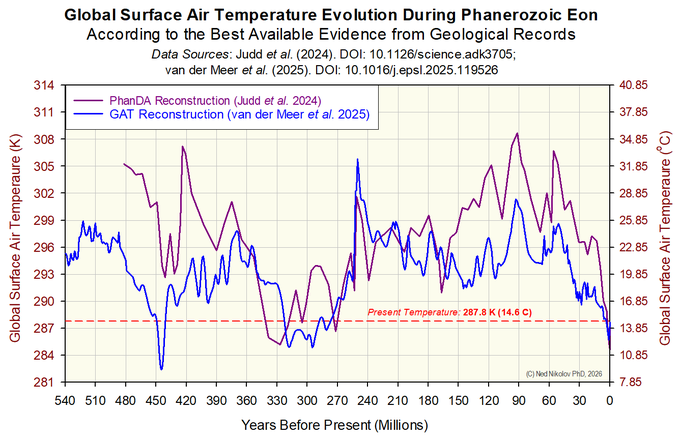
New scientific modeling has proposed a significant revision to paleoclimatology, asserting that the mechanics of Earth's tectonic plates are a more fundamental driver of long-term climate oscillations than previously recognized. Research published in January 2026 in the journal Communications, Earth and Environment, led by Dr. Ben Mather of The University of Melbourne and Professor Dietmar Müller of the University of Sydney, reconstructed the movement of carbon through the planet's interior, oceans, and atmosphere across the last 540 million years.
This comprehensive reconstruction couples global plate tectonic models with detailed carbon-cycle simulations, establishing a new framework for understanding the planet's transitions between frigid 'icehouse' states and warm 'greenhouse' worlds. The study challenges the long-standing scientific consensus that pinpointed volcanic arcs, formed at converging plate boundaries, as the principal natural source of atmospheric carbon dioxide. The new evidence indicates that for the vast majority of geological time, the primary mechanism regulating atmospheric CO2 levels involved the spreading of tectonic plates.
Specifically, mid-ocean ridges and continental rifts, where the crust pulls apart, were identified as the more significant sources of carbon release into the atmosphere. This finding is intrinsically linked to the deep carbon cycle, where oceans sequester carbon dioxide into deep-sea sediments, which are then returned to the interior via subduction zones. The modeling successfully predicted the major climate states across the 540-million-year span, correlating greenhouse periods with a net release of carbon exceeding sequestration, while icehouse climates were characterized by dominant carbon burial in ocean sediments.
A critical temporal distinction emerged: volcanic arc emissions, such as those around the Pacific Ring of Fire, only became the dominant carbon source within the last 100 million years. Professor Müller, affiliated with the University of Sydney's School of Geosciences and leader of the EarthByte research group, noted that this shift correlates with the evolution and proliferation of planktic calcifiers, a type of phytoplankton, which began sequestering substantial carbon into seafloor deposits approximately 150 million years ago. Dr. Mather emphasized that this deep-time perspective is vital for refining contemporary climate models.
The research underscores that the planet's long-term climate stability is governed by the dynamic balance between carbon release at spreading boundaries and its subsequent burial in deep-sea reservoirs. This work provides a more nuanced understanding of Earth's natural thermostat, which has operated through processes more complex than simple volcanic outgassing alone.