



CIA won't deny it has 3I/Atlas records monitoring mystery suspected UFO dailystar.co.uk/news/latest-ne…

Share
Edited by: undefined undefined
CIA won't deny it has 3I/Atlas records monitoring mystery suspected UFO dailystar.co.uk/news/latest-ne…
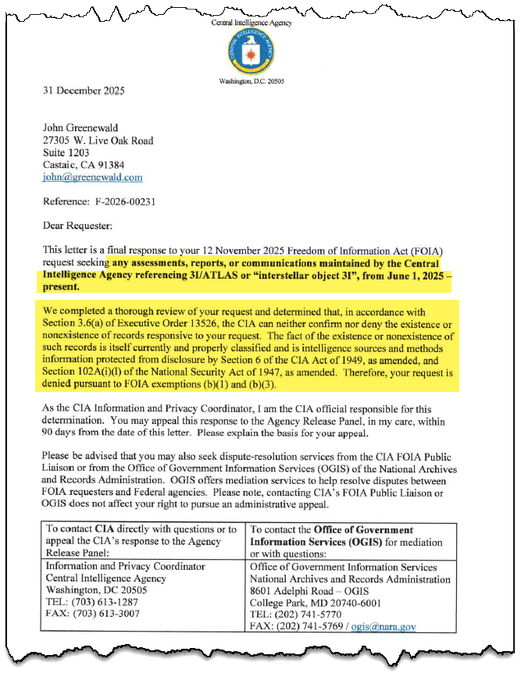
On December 31, 2025, the Central Intelligence Agency (CIA) issued a response to a Freedom of Information Act (FOIA) request. In this official statement, the agency maintained that it could neither confirm nor deny the existence of any documentation related to the interstellar comet designated 3I/ATLAS. The justification for withholding information cited both Executive Order 13526 and the CIA Act of 1949, grounding the potential records in a classified status. This official stance regarding a widely observed astronomical phenomenon has since ignited considerable debate among the public and within research communities.
🚨The CIA will "neither confirm nor deny the existence or nonexistence of records" pertaining to interstellar object 3I/ATLAS. The fact of documents existing or not existing is classified.
The celestial body, known scientifically as 3I/ATLAS or C/2025 N1 (ATLAS), was first documented on July 1, 2025. This discovery marked it as the third confirmed visitor from interstellar space to traverse our Solar System, following the earlier detections of 1I/ʻOumuamua and Comet 2I/Borisov. While NASA representatives definitively classified the object as a natural comet on November 19, 2025, the CIA's subsequent reaction raised eyebrows. Harvard astrophysicist Avi Loeb expressed surprise at NASA's categorical assurance, given the intelligence community's opaque response. Loeb speculated that the CIA's refusal might indicate the intelligence apparatus's desire to monitor a potential 'black swan' event without immediately alerting the general populace.
Following its passage through perihelion on October 29, 2025, the comet exhibited behavior that deviated from the norm. Specifically, it ejected a jet directed toward the Sun, which is atypical for the standard formation of a cometary tail. Estimates placed the comet's nucleus diameter at approximately 5.6 kilometers. Furthermore, spectral analysis revealed an elevated concentration of nickel. Some researchers suggested this composition was more indicative of manufactured materials than typical cosmic ice. Despite the intrigue, an analysis conducted by the Breakthrough Listen project in December 2025 failed to detect any compelling narrow-band radio signals emanating from 3I/ATLAS.
The object made its closest pass to Earth on December 19, 2025, at a distance of 1.8 astronomical units (AU). By January 6, 2026, it was already on its outbound trajectory, leaving the Solar System’s confines. Current research attention is now pivoting toward the comet’s maximum approach to Jupiter, scheduled for March 16, 2026, when it is projected to pass within roughly 53.6 million kilometers of the giant planet. John Greenewald Jr., who spearheaded the initial FOIA inquiry, has formally appealed the CIA's determination. Greenewald argues that the mere existence of foundational records should not inherently compromise national security.
The CIA's application of what is often termed the 'Glomar response' concerning a celestial body whose natural origin has been scientifically validated by NASA presents a stark contradiction. This action suggests that intelligence agencies operate under a different risk assessment framework. In this context, mitigating the consequences of extremely low-probability, high-impact scenarios appears to take precedence over maintaining scientific transparency regarding this specific object. Regardless of the comet's true nature, the secrecy imposed by the CIA effectively elevates 3I/ATLAS beyond a routine astronomical observation, placing it firmly within the purview of intelligence interests and potentially setting a new precedent for handling future interstellar visitors.
Mashable India
Mashable ME
The Interstellar Comet That's Spilling Its Secrets—3I/ATLAS Water Production
If 3I/ATLAS is a Comet, Why Would the CIA “Neither Deny, Nor Confirm” the Existence of Records on It? | by Avi Loeb
Astronomers examine rare interstellar comet for signs of technology - Chron
Comet 3I/ATLAS Facts and FAQS - NASA Science
VICE
The Economic Times
Mashable ME
Medium
A new cosmic visitor is lighting up the sky☄️ Comet R3 (PanSTARRS) is showing off a long, wispy tail created as sunlight heats its icy core and the solar wind sweeps charged gas into space. Its feathered look changes constantly as space weather shifts. Visible before dawn in

How fast is our universe expanding? About ~73.5 km/s per megaparsec, aligned with past measurements but with greater precision. Using data from @NASAWebb and @NASAHubble, astronomers worldwide are bringing us closer to a precise measurement: go.nasa.gov/4t3N6lS

White dwarfs inherit hidden magnetic fields from red giants - universemagazine.com/en/white-dwarf…


