



The Greenland ice sheet, the largest non-Antarctic ice reservoir, is undergoing sustained and significant mass reduction in early 2026, reinforcing its role as a primary driver of global sea-level fluctuations. The Copernicus Sentinel-2 mission recently provided high-resolution satellite imagery focused on the southeastern sector, documenting the steep glacial cliffs near the Helheim Glacier, a major conduit for ice discharge into the ocean. This continuous satellite surveillance is essential for accurately charting the dynamics of this massive ice body and its contribution to global ocean volumes, noting that every 360 gigatonnes of ice lost from Greenland corresponds to a 1-millimeter rise in global sea levels.

"not a Greenland-wide...warmer than today" The Greenland-wide ice sheet had warm periods "more than 5°C above present" and the melt volume was so much greater than today that GIS contributed up to 1.2 m more to sea level rise. Retreat margins were 100 km beyond today's.
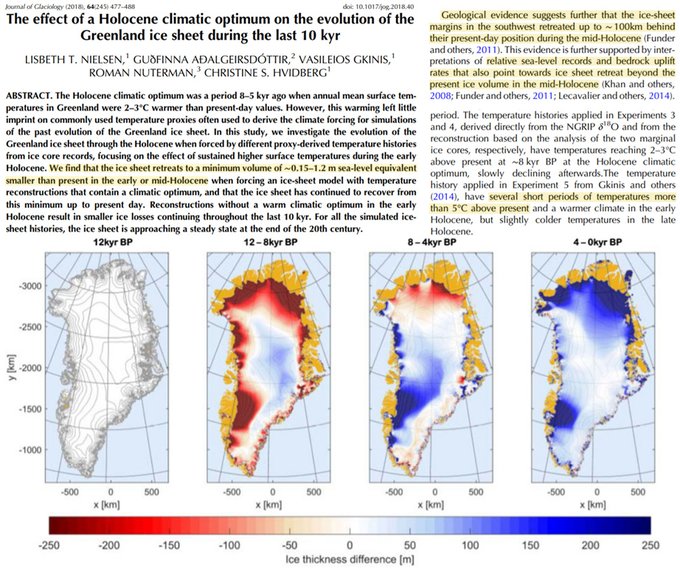
Historical context suggests a precedent for rapid ice loss, as revealed by the GreenDrill Project. Researchers drilling over 500 meters of ice at the Prudhoe Dome in northwest Greenland discovered chemical signatures in sediment dating back approximately 7,100 years, indicating the dome completely melted during a Holocene warm period. During that time, summer temperatures were estimated to be 3 to 5 degrees Celsius warmer than current levels—conditions that climate models project could recur by 2100 under current greenhouse gas emission pathways. This historical retreat offers a critical constraint on the physical sensitivity of the ice sheet to modest warming.
Compounding surface melt concerns are geological factors influencing the ice from below. Detailed three-dimensional models produced by a team led by the University of Ottawa indicate that uneven heat is trapped beneath the ice, a consequence of Greenland's ancient traverse over a volcanic hotspot, likely the Iceland hotspot. This geothermal anomaly, spanning a quarter of Greenland's land area and established between 80 and 35 million years ago through tectonic processes, thinned the ice at depth and created a region with abundant subglacial meltwater, affecting the basal lubrication and flow rate of the ice sheet today.
The massive influx of freshwater from this accelerated melting into the North Atlantic Ocean presents a substantial threat to the stability of the Atlantic Meridional Overturning Circulation (AMOC), a vital component of global ocean heat transport. A slowdown or potential disruption of this current system, which involves the sinking of dense North Atlantic Deep Water near Greenland, could significantly alter regional climate patterns across the Northern Hemisphere. Research coordinated by the University of Liège, utilizing the NIC5 supercomputer, projects that under a high emissions scenario (SSP585), Greenland could lose between 964 to 1,735 gigatonnes of ice annually by 2100, potentially leading to a sea-level rise of up to one meter. This ongoing process is being closely monitored by institutions such as the Polar Portal, a joint project involving four Danish government research institutions.


