


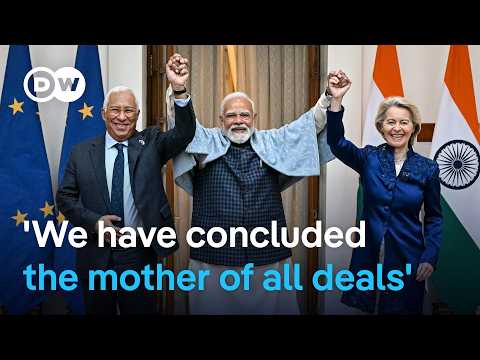
EU and India Seal Historic Comprehensive Free Trade Agreement in New Delhi
Edited by: Tatyana Hurynovich
On January 27, 2026, New Delhi hosted the landmark Sixteenth India-EU Summit, where the European Union and India officially signed a comprehensive Free Trade Agreement (FTA). Ursula von der Leyen, President of the European Commission, famously labeled the pact as the "mother of all deals." This historic signing marks the culmination of a long-standing diplomatic journey that first began in 2007 and saw a significant revival in 2022 after years of stagnation.
This monumental agreement establishes a massive free trade zone encompassing a combined population of 2 billion people. It signals a profound strengthening of economic and strategic ties between two of the world’s most dominant economies, which together account for approximately 25% of the global GDP. Central to the deal is a radical liberalization of market access: the EU has committed to removing or slashing tariffs on 99.5% of Indian goods, while India will provide tariff concessions covering 97.5% of the commercial value of European exports. Consequently, European exporters are projected to save up to 4,000 billion euros annually in duties, with EU exports to India expected to surge by 107.6% by the year 2032.
Detailed provisions within the agreement highlight significant breakthroughs in specific sectors. India has pledged to phased reductions in automotive duties, dropping from 110% to just 10% by 2030, alongside the total elimination of tariffs on car parts within a five-to-ten-year window. Wine tariffs will also see a progressive decline from 150% to a minimum of 20%. Furthermore, the deal includes the removal or reduction of duties on European machinery (up to 44%), chemicals (up to 22%), and pharmaceuticals (up to 11%). European firms will also gain preferential access to India's services market, particularly in financial and maritime transport. However, the EU will maintain protective tariffs on sensitive agricultural products, including beef, sugar, and rice.
Beyond the purely commercial aspects, the summit saw the launch of the inaugural EU-India strategic partnership focused on security and defense, highlighting the geopolitical weight of this alliance. Experts suggest that this cooperation carries a heavy strategic dimension, aimed at cementing ties with India as a pivotal global power. The agreement is viewed as a cornerstone of a broader de-risking strategy intended to diversify international trade routes. Additionally, the pact encompasses robust protections for intellectual property rights and a memorandum on global mobility cooperation, designed to facilitate the movement of students and skilled professionals between the two regions.
By 2025, the bilateral trade in goods and services had already surpassed 180 billion euros, cementing the EU's position as New Delhi's primary trading partner. Indian Prime Minister Narendra Modi hailed the agreement as a "perfect example of partnership" destined to bring stability to the global order. Following a period of legal scrubbing and expertise expected to last five to six months, the treaty is slated to officially enter into force during the 2026 calendar year.
32 Views
Sources
STARTUPPER
LA TERCERA
European Commission
THE TIMES OF INDIA
The Hindu
The Guardian
European Automobile Manufacturers' Association (ACEA)
The Hindu
The Times of India
European Commission
Mint
Press Information Bureau
Read more news on this topic:


Did you find an error or inaccuracy?We will consider your comments as soon as possible.