


As of 02:00 UTC on January 20, 2026, our planet is navigating the heart of one of the most intense space weather events recorded in recent decades. Just twenty-four hours after a massive solar flare, Earth was struck by a direct coronal mass ejection. This collision has triggered a rare double-threat: a Level S4 solar radiation storm—the most powerful since 2003—and an extreme G4.33 geomagnetic storm on the five-point intensity scale.

An S4 severe solar radiation storm is now in progress - this is the largest solar radiation storm in over 20 years. The last time S4 levels were observed was in October, 2003. Potential effects are mainly limited to space launch, aviation, and satellite operations.

The sequence of events began with a dramatic surge in high-energy proton flux, which reached its peak during the evening of January 19 UTC. The flow of particles with energy levels exceeding 10 MeV skyrocketed to an unprecedented 37,000 units. This figure not only surpassed the levels seen during the legendary 2003 Halloween solar storms but also set a new record for the 21st century. This surge initiated an S4 radiation storm, the first of this magnitude in the last two solar cycles. Such intense radiation environments pose significant threats to satellite operations, high-frequency radio communications, and commercial aviation on polar flight paths.
The situation reached its climax when the primary plasma cloud and its associated shockwave slammed into Earth's magnetosphere at approximately 19:48 UTC on January 19. Data analysis indicates that the plasma traveled the final 1.5 million kilometers of its journey in a mere 15 minutes, implying a staggering velocity of nearly 1,700 km/s. The impact was so violent that it disabled the speed sensors on the ACE monitoring satellite. The electromagnetic pulse from the shockwave pushed interplanetary magnetic field parameters to extreme levels, with Bt hitting 87 nT and Bz dropping to -32 nT. While the field eventually stabilized, it remained at high levels with Bt around 35 nT and Bz at -23 nT, sustaining the intense geomagnetic disturbance.

HP30 values of 10 reached during the first 3 hours of the impact. A Kp index of 9 = a G5 storm. If/the moment this solar storm magnetic field flips negative, we're in for some absolute MADNESS
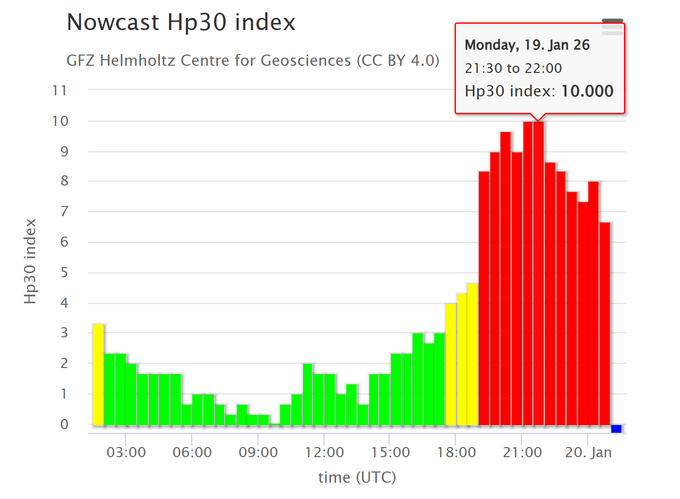
By January 20, official reports confirmed a planetary magnetic storm rating of G4.33, placing the event just a fraction away from the maximum G5 level. While the Potsdam Center, responsible for calculating the global index, maintains this figure, several localized stations have reported even higher disturbances. The current scenario is particularly unique because the planet is being bombarded by two top-tier phenomena—radiation and geomagnetic storms—simultaneously, a convergence that occurs very rarely in solar history.
The atmospheric consequences have been nothing short of spectacular. Vibrant and highly dynamic auroras were observed throughout the night across Scandinavia and Canada, with sightings extending as far south as the 45th and 50th parallels. Reports of these celestial lights even emerged from Central Europe. Regarding technological infrastructure, the primary impact on power grids has been mitigated thus far, thanks to proactive measures taken by grid operators. However, the load on these systems remains substantial as the storm persists.
Scientific teams across the globe remain on high alert, providing around-the-clock monitoring of the situation. The central question currently facing researchers is whether the storm will cross the threshold into a G5 event. Such an escalation would be a historic milestone, comparable only to the legendary storms of 2003 or 2024. The next few hours are expected to be the most critical as experts wait to see if this solar event will rewrite the record books.


