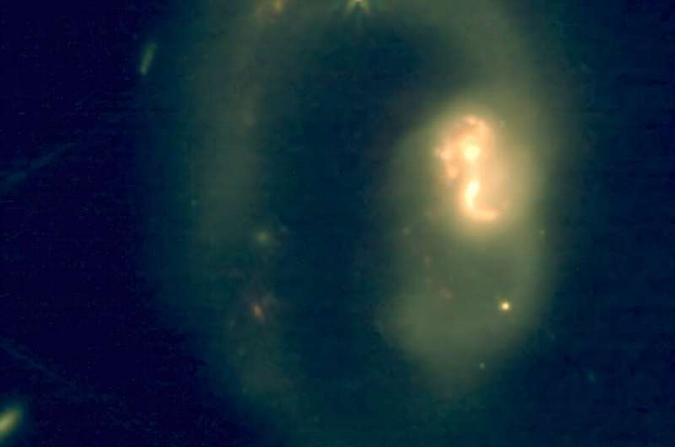
JWST detected an unexpected number of organic molecules in the ultraluminous galaxy IRAS 07251-0248.
The James Webb Space Telescope (JWST) has achieved a major breakthrough by identifying a high concentration of organic compounds within the central region of the galaxy IRAS 07251-0248. This discovery challenges previous assumptions regarding the chemical complexity possible in such extreme cosmic environments. As an ultraluminous infrared galaxy, IRAS 07251-0248 possesses a core obscured by dense layers of gas and dust, which historically shielded it from traditional optical observations. However, a study published in Nature Astronomy on February 6, 2026, utilized the JWST’s NIRSpec and MIRI instruments to pierce this veil, analyzing infrared emissions across the 3 to 28-micron range.
Although these molecules are absent from living cells, it is believed that they play a key role in the formation of amino acids and nucleotides (prebiotic chemistry that leads to the origin of life).
These sophisticated observations confirmed the presence of several gas-phase molecules, including benzene (C₆H₆), methane (CH₄), acetylene (C₂H₂), diacetylene (C₄H₂), and triacetylene (C₆H₂). Perhaps the most significant finding was the first-ever extragalactic detection of the methyl radical (CH₃). Dr. Ismael García-Bernete, the lead author and a researcher at the Center for Astrobiology (CAB), noted that the observed chemical abundance and complexity far exceed the predictions of current theoretical models. This suggests that these galactic cores must possess a continuous source of carbon to sustain such a vibrant and intricate chemical network.
The small molecules identified are considered vital precursors for prebiotic chemistry, directly linked to the formation of more complex biological structures. Professor Dimitra Rigopoulou, a co-author from the University of Oxford’s Department of Physics, emphasized that these compounds are essential in the synthesis of amino acids and nucleotides. Utilizing advanced modeling developed at Oxford, the research team suggests that the extreme conditions within the galaxy—beyond just high temperatures or turbulence—actually serve as a catalyst for this sophisticated chemistry.
Researchers believe the primary mechanism driving this production is the fragmentation of polycyclic aromatic hydrocarbons (PAHs) and carbon-rich dust grains. This process is triggered by intense cosmic ray bombardment, which is prevalent in these active galactic cores. The study found a clear correlation between the abundance of hydrocarbons and the level of ionization caused by cosmic rays in similar galaxies. Consequently, these findings indicate that shielded galactic nuclei like IRAS 07251-0248 act as universal "factories" for organic molecules, playing a critical but previously overlooked role in the chemical evolution of the universe.
Spectroscopic analysis also allowed the team to characterize elements associated with ice and dust particles alongside the gas-phase molecules. Data from the JWST revealed that these gas-phase molecules are part of an outflow moving at approximately 160 kilometers per second. This suggests a cyclical process where carbon fragments are propelled outward, eventually freezing or aggregating in cooler regions of the galaxy. This collaborative effort between experts from CAB and the University of Oxford highlights the transformative power of the JWST in exploring the most secluded and chemically rich corners of space.