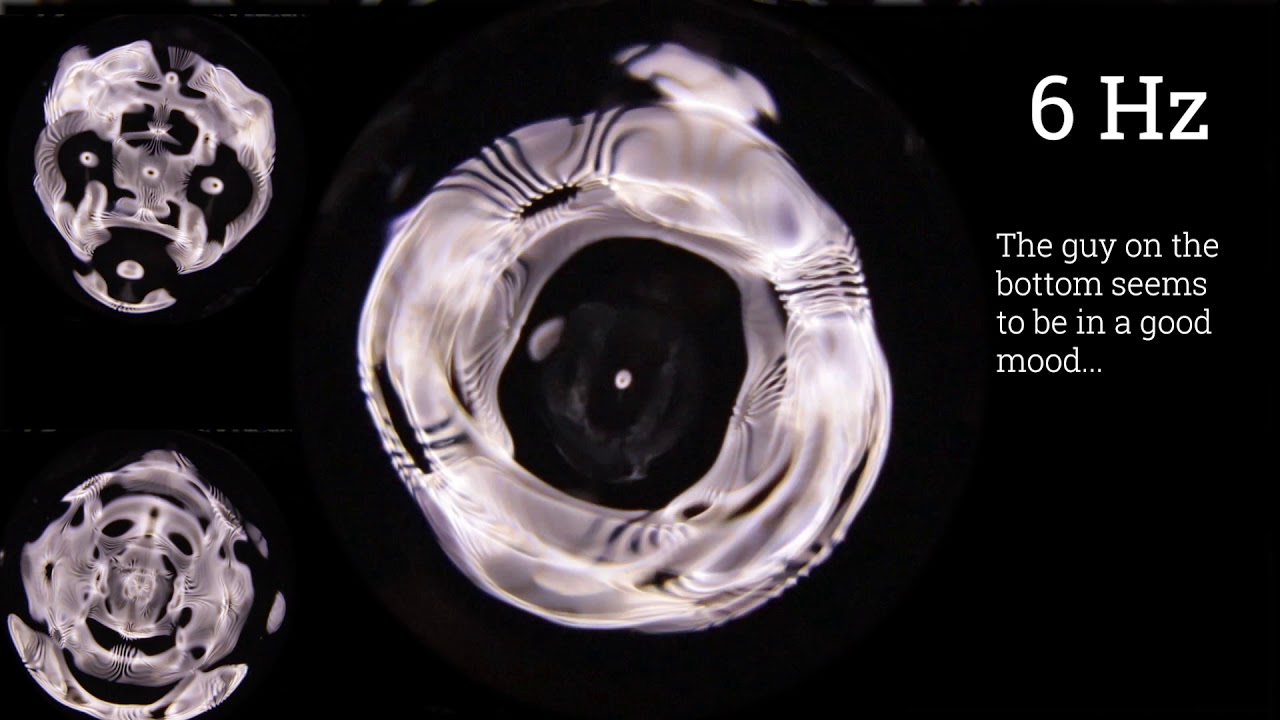
Cymatics Experiment 1Hz - 10Hz square wave sound visualization
Share
Author: Inna Horoshkina One
Cymatics Experiment 1Hz - 10Hz square wave sound visualization
In today's world dominated by quick swipes, it often seems like people choose partners based solely on a profile picture and a single witty line. However, fresh analysis from the music-focused dating application Vinylly suggests a different reality: often, the first word spoken in a potential connection comes from the playlist.
Vinylly recently examined 5,000 interactions over the past year, revealing a sharp divergence in how men and women utilize music at the outset of communication. Women tend to scroll through profiles less frequently but are significantly more inclined to hit the 'play' button, resulting in nearly 17,000 track listens. Conversely, men review approximately twice as many profiles and initiate nearly six times more direct messages.
To put it plainly, the data suggests distinct uses for musical expression:
Men use music primarily to present themselves—it functions as an image, a style statement, or a personal 'brand.'
Women, on the other hand, leverage music to gauge emotional compatibility—asking the internal question, 'Can I feel the same way as this person?'
Bowie Versus Drake: Whose Influence Dominates?
Vinylly’s tracking also highlights differences in artist preference. Women frequently gravitate toward artists carrying strong emotional weight and historical depth, such as David Bowie, Fleetwood Mac, The Beatles, and Billie Eilish. Men’s choices lean toward Drake, Metallica, Radiohead, and Kendrick Lamar. Interestingly, certain names, like Taylor Swift and Radiohead, emerge as crucial 'compatibility bridges'—points where tastes overlap, frequently sparking mutual interest.
This pattern extends to live music experiences. Women are more likely to reference concerts by Taylor Swift, Usher, and Pink, while men tend to cite Iron Maiden, Metallica, and Green Day. Geographically, the majority of users reside in major metropolitan areas known for vibrant live scenes, including New York, Los Angeles, London, and Seattle.
The modern dating map is increasingly resembling a series of musical routes: city to venue, concert to curated playlist.
Relationship psychology is beginning to embrace this musical motif. A review titled 'Love songs and serenades' (Bamford et al., 2024) posits that music functions in two primary modes within romantic relationships: first, as a signal during partner selection (where we 'showcase ourselves' through tracks and playlists), and second, as a bridge that sustains attachment later, fostering a sense of 'our shared world.'
Furthermore, the study 'Music across the love-span' (Vigl et al., 2024/2025) surveyed 174 participants on their music use across relationship stages, from initial crushes to long-term unions. The finding was that music intensifies intimacy and the sense of 'us' early on, and later helps couples revisit shared memories and navigate conflicts. Separate research also indicates that listening to pop ballads about love can subtly shift mindsets, potentially increasing commitment readiness or, conversely, triggering jealousy, depending on the song's narrative and the listener's personal history.
A crucial nuance emerges from a large-scale study on musical taste and well-being (2025): the genre itself does not guarantee happiness—its influence is minor, often explained by shared genetic and social factors. Therefore, music serves as an excellent indicator, but it is not a guarantee of an ideal relationship.
In the context of our current discussion, this means music acts not as a 'magic filter,' but as a subtle tool for recognition: assessing how similarly we experience and process emotions.
A fresh perspective comes from the work 'Modeling Musical Genre Trajectories through Pathlet Learning' (Marey et al., 2025), developed in collaboration with Deezer Research. Researchers analyzed 17 months of listening history from 2,000 users, categorized by genre, and proposed describing tastes not as a static list, but as a trajectory. They introduced the concept of pathlets—small, frequently recurring 'pieces of the listener's path,' such as the late-night shift from indie rock to ambient, or Sunday transitions from pop hits to jazz. These patterns construct an individual map of genre movement.
The core concept here is that a musical profile is not a fixed 'I like this' statement, but rather a living trajectory reflecting personal evolution, emotional states traversed, and new internal worlds discovered. What Vinylly captures as the current playlist is merely one frame from a long film: encompassing teenage rock, music from past crises, and tracks marking a 'new life.'
The common phrase 'we vibrate on the same frequency' easily slips into metaphor. However, a simple physical demonstration brings this concept into reality. In cymatics experiments, sand is spread on a metal plate and vibrated at various frequencies. Each frequency causes the sand to organize into distinct patterns—grids, stars, or concentric shapes. These are the classic Chladni figures: visible patterns created by sound.
The conclusion here is direct: sound is more than what we hear; it is a wave that structures reality. Something far more subtle occurs within us when we listen to music together. Studies on synchronous listening show that when people listen to the same track simultaneously, their heart rates and breathing synchronize, stress levels drop, and trust increases, fostering a feeling of 'being together.'
In the language of shared experience, a common song generates a shared pattern across two nervous systems—a collective geometry of feeling.
The idea of 'form as code' is currently appearing in genomics research. In a study by Almassalha et al. (Advanced Science, 2025), it was demonstrated that for cells, the spatial arrangement of DNA segments within the nucleus is as vital as the sequence itself. Exons, introns, and intergenic regions combine to create layers and domains where the cell stores its 'self-memory': its tissue type and appropriate responses to signals.
To put it simply: sound draws a pattern in sand on a plate, and DNA draws a pattern within the cell's volume so the body remembers its identity. Life codes itself not just in sequence, but in shape.
All these threads converge: psychology confirms shared music is both a signal of attraction and a bond in a relationship; services like Vinylly document real-world playlist-based selection; Deezer research shows taste is a trajectory; cymatics proves sound creates visible geometry; and genomics adds that life itself is stored in memory geometry.
Somewhere in the middle of all this is SOUND—the music that draws together people whose feelings share a compatible geometry. The dating app playlist then ceases to be merely a collection of tracks. It becomes:
A miniature map of the user's journey,
A trial run of shared vibration: 'Do we hear the world similarly?'
Musical taste doesn't guarantee a 'happily ever after.' But it helps the planet gently align resonances, ensuring that those who sound kindred on the inside meet not just eye-to-eye, but heart-to-heart, within the same musical geometry.
Perhaps this is why sometimes, just one shared song playing through headphones is enough to suddenly realize: Music recognized us in each other before we even had a chance to speak.
Exploring the Impact of Music on Dating in Today’s World
Vigl J. et al. (2024). Music across the love-span: a mixed methods study into the use of music in romantic relationships.
Bratchenko A. et al. (2025). Music style preferences and well-being: A genetic perspective.
Marey L. et al. (2025). Modeling Musical Genre Trajectories through Pathlet Learning.
Tschacher W. et al. (2024). Physiological audience synchrony in classical concerts.
Almassalha L.M. et al. (2025). Geometrically Encoded Positioning of Introns, Intergenic Segments, and Exons in the Human Genome.
Almassalha L.M. et al. (2025). Geometrically Encoded Positioning of Introns, Intergenic Segments, and Exons in the Human Genome.
Tschacher W. et al. (2024). Physiological audience synchrony in classical concerts.
Did you find an error or inaccuracy?
We will consider your comments as soon as possible.