


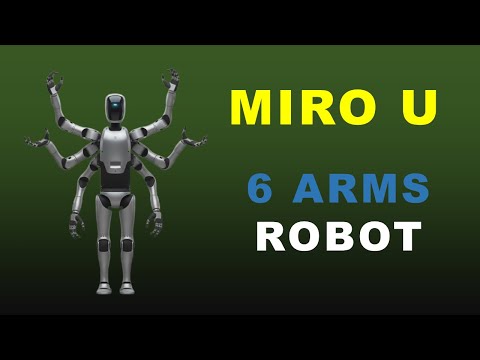
Chinese conglomerate Midea Group officially introduced its new humanoid robot, the MIRO U, on December 5, 2025. The unveiling took place during the Greater Bay Area New Economy Forum held in Guangzhou. Midea is positioning this advanced creation as a "super-humanoid," deliberately choosing to diverge from an exact imitation of human anatomy. This strategic decision prioritizes multidimensional operational efficiency tailored specifically for demanding industrial environments. The MIRO U represents the third generation in Midea's ongoing series of sophisticated robotic development projects.
The defining characteristic of the MIRO U is its inclusion of six bionic arms, a feature that empowers the robot to manage concurrent, multi-task operations seamlessly. The internal design structure strategically segregates functions. The lower appendages are engineered to provide robust stability and manage the transportation of heavy components. Conversely, the upper set of arms is dedicated to executing highly precise assembly tasks. This specialization allows for optimized performance across various operational requirements.
Further enhancing its adaptability, the robot is equipped with modular end effectors. These tools can be rapidly interchanged, allowing the MIRO U to quickly pivot between different production requirements on the factory floor. Instead of relying on traditional bipedal locomotion, the MIRO U utilizes a wheeled-legged chassis. This system facilitates stable vertical elevation and grants the robot the crucial ability to rotate a full 360 degrees in place, which is vital for navigating congested manufacturing areas with agility.
Wei Chang, the Chief Technology Officer at Midea, emphasized that the true value proposition of the MIRO U lies in achieving a significant leap in operational performance when compared to conventional robotic systems. The company projects that once fully integrated into production lines, the robot could boost efficiency in both line changeovers and process adjustments by an impressive 30 percent. Preparations are underway for pilot testing of this technology, scheduled to commence by the close of December 2025 at Midea's advanced washing machine manufacturing facility located in Wuxi, Jiangsu Province.
Midea's sustained advancement in robotics is intrinsically linked to its broader corporate strategy, which began with significant investments in the German industrial robotics manufacturer KUKA back in 2015. By 2017, Midea had secured a controlling stake in KUKA, culminating in the complete acquisition by 2022. Wei Chang has previously outlined a three-tiered research and development strategy: enhancing the intelligence of industrial robots through artificial intelligence integration, automating white goods and home appliances, and developing advanced humanoid robots, including the "super-humanoids" like the MIRO U. Alongside the industrial MIRO series, Midea is also developing the "Meila" series, targeted at commercial and domestic applications, with a launch anticipated in 2026.
The introduction of the MIRO U arrives amidst a significant regional push, reinforced by the 15th Five-Year Plan, which strongly advocates for the adoption of "New Quality Productive Forces," emphasizing the accelerated integration of robotics across industries. Experts view this engineering philosophy—one that deliberately moves away from strict anthropomorphism in favor of functional multi-limbed capability—as a sign of maturity. This approach is clearly geared toward maximizing throughput capacity within the framework of Industry 4.0 modernization efforts.


