


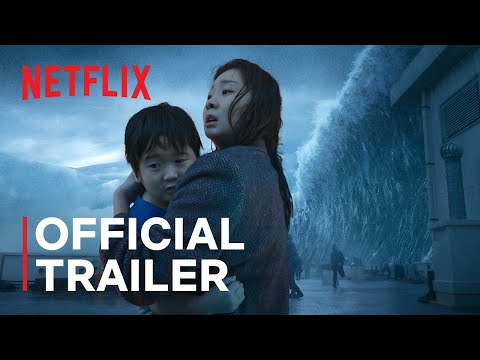
Netflix's 'The Great Flood': Mixed Reception for Sci-Fi Survival Drama Fusion
Edited by: An goldy
The global streaming premiere of the South Korean film, 'The Great Flood' (also known as 'The Great Flood'), on Netflix on December 19, 2025, immediately sparked a noticeable divergence of opinions among both viewers and professional critics. Directed by Kim Byung-woo, a filmmaker recognized for his previous works like 'Terror Live' (2013) and 'Ashfall' (2018), this feature is a large-scale science fiction blockbuster. The narrative centers on an AI researcher and her son struggling to survive a catastrophic deluge overwhelming Seoul.
Director Kim Byung-woo, born in 1980, is known for prioritizing the conveyance of his authorial message. As observed in his prior filmography, this focus can occasionally result in a narrative structure that proves challenging for some audiences. This ambitious blending of high-stakes disaster spectacle with intricate theoretical exploration has led to highly polarized reviews.
The critical consensus, as reflected on the aggregator Rotten Tomatoes, settled at a 60 percent approval rating from professional reviewers. However, the audience reception proved significantly cooler, with the Popcornmeter score registering only 39 percent based on over 50 user ratings. Many online commentators pointed to what they perceived as jarring and ill-timed shifts from the intense survival drama into dense expository segments concerning artificial intelligence theory and simulation concepts. These segments, many felt, pulled focus away from the story's emotional core.
Despite these structural criticisms, the performances received high praise. Specifically lauded were Kim Da-mi's portrayal of the AI researcher, Anna, and Park Hae-soo’s turn as security officer Hee-jo. The initial action sequences were also highlighted as strong points of the production.
The film's plot unfolds as scientist Anna and her son find themselves trapped in a submerged high-rise building in Seoul. This crisis is triggered by a global flood, itself caused by the melting of polar ice caps following a meteorite impact. As the story progresses, it becomes clear that Anna’s work at a secret UN laboratory, involving the AI 'Emotion Engine,' holds the key to humanity's continued existence. Furthermore, the film hints that her son might be an integral part of her experiment designed to replicate maternal devotion.
The movie operates simultaneously on two distinct planes: the immediate physical destruction and a more abstract philosophical threat. This dual approach, according to the director's intent, positions the film as a thought experiment rather than a straightforward disaster flick. This complexity is what likely contributed to the mixed critical reception.
Notwithstanding the divided critical reception, 'The Great Flood' rapidly secured a spot within Netflix's global Top 10 rankings. This immediate popularity underscores the substantial international appetite for this particular project. This success further illustrates the significant global advantage held by South Korean productions on the streaming platform, where curiosity surrounding high-concept content often outweighs critical reservations.
Overall, the film demonstrates a key trend in the current OTT landscape: genre appeal and strategic positioning frequently play a more decisive role in achieving high viewership numbers than achieving unanimous critical approval.
159 Views
Sources
International Business Times UK
Vertex AI Search
Vertex AI Search
Vertex AI Search
Vertex AI Search
Read more articles on this topic:


#ProjectHailMary screenwriter Drew Goddard is writing and directing "The Matrix 5" and says "I can't speak" to whether or not Keanu Reeves is returning or not. "I can’t say too much, because we’re still in the stage of writing it. I need to give myself space to find the best


Did you find an error or inaccuracy?We will consider your comments as soon as possible.