


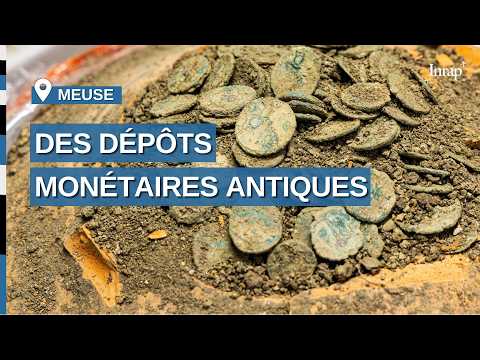
A substantial cache of late Roman coinage has been brought to light by archaeologists from the National Institute for Preventive Archaeological Research (INRAP) in the Meuse department of eastern France, close to the commune of Senon. This significant discovery occurred on private land where the owner was planning a home extension, which mandated the standard preliminary archaeological surveys. The excavation covered an area spanning roughly 1,500 square meters, providing an unprecedented look into a previously under-investigated sector of the ancient settlement.
Researchers confirmed that the coins were deliberately concealed within three distinct ceramic vessels situated inside residential structures. Two of these amphorae have already been opened; one contained an estimated 25,000 small bronze coins. Current projections suggest the total count of the discovered items could reach as high as 40,000 specimens. The third vessel has been carefully preserved and transferred to a laboratory for in-depth analysis to precisely ascertain the composition and characteristics of its contents. All the coins bear the likenesses of Roman emperors, and the deposition itself is securely dated to the period between 280 and 310 CE.
The precise manner in which the containers were positioned immediately caught the attention of the archaeological team. The amphorae were set upright in purpose-dug pits, with their mouths positioned almost level with the ancient floor surface. This orderly placement strongly implies a calculated and systematic storage method, rather than a hurried attempt to bury valuables during a period of crisis. Further evidence supporting this interpretation comes from several coins found adhering to the exterior surfaces of two of the jars—these must have been affixed after the containers were already situated in their final resting places.
The true scientific merit of this find lies less in the sheer volume of the currency and more in the exceptionally well-preserved archaeological context surrounding it. Unlike hoards recovered without controlled excavation, this discovery allows experts to reconstruct the exact circumstances of its concealment with high fidelity. Simon Ritz, the excavation coordinator, posited that this might represent a systematic withdrawal of currency from circulation during a monetary reform enacted under the late Roman Empire. He drew a parallel to modern times, comparing it to the gradual phasing out of old banknotes when a new currency, like the Euro, is introduced.
The archaeological data gathered also illuminates the broader history of the site itself. In antiquity, Senon was situated within the territory of the Gallic tribe known as the Mediomatrici, whose capital city was Divodurum, which is modern-day Metz. Urban development in this area commenced toward the close of the 1st century CE, marking a transition from structures built primarily of earth and timber to more permanent stone construction. However, the settlement suffered a major conflagration at the beginning of the 4th century. After a period of rebuilding, life in the quarter was short-lived, as a subsequent, devastating fire in the mid-4th century led to the area being permanently abandoned.
While the bronze coins themselves may not possess immense intrinsic value, their organized storage and the meticulously documented context offer a rare window into the economic mechanisms of Late Antiquity. The forthcoming laboratory studies on the third amphora and associated artifacts are expected to shed further light on the function of these accumulations within the local economy and definitively confirm the rationale behind their deliberate hoarding.


