


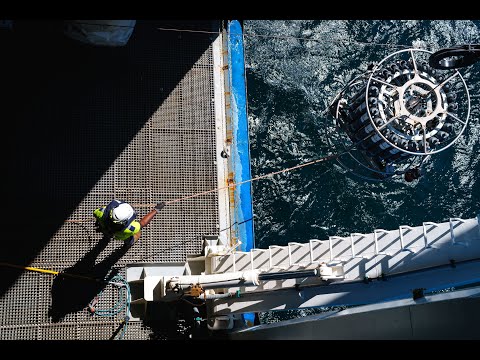
Artist Richelle Ellis journeyed to the South Atlantic not as a mere observer, but as a translator. She was not searching for new species; instead, she sought a way to perceive what typically lies beyond the reach of human awareness. Her mission was not to measure the ocean, but to sense its underlying processes and give them tangible form.
Between Orbit and the Depths
She has been captivated by patterns since childhood. Her first real inspiration struck while viewing Earth from high above, where she realized that landscapes, clouds, river systems, and currents are all intrinsically linked.
Since then, her work has navigated the space between two distinct realms: planetary orbit and the depths of the sea.
To her, these are not opposites. They are dual reflections of a single, unified system.
Seeing Processes Rather Than Forms
During an expedition with the Schmidt Ocean Institute, she worked alongside scientists studying one of the planet's largest living mechanisms—the South Atlantic subtropical gyre.
While technical instruments recorded the data:
- the movement of particles
- the exchange of nutrients
- the transport of carbon
she focused on something else entirely:
- rhythm
- recurrence
- connectivity
Translating the Invisible
Her toolkit extends far beyond the traditional paintbrush, as she works with:
- satellite imagery
- oceanographic data
- materials physically transformed by pressure, light, and the passage of time
Through these means, she creates forms that cannot be perceived directly by the naked eye.
This is not merely an illustration of scientific facts. It is an attempt to experience the essence of science from within.
Depth as a Mirror
The deeper one descends, the less room there is for coincidence.
In the ocean, this manifests as a complex system of currents; in space, as the vast architecture of galaxies; and within the human spirit, as an expansion of perception.
Here, an ancient principle emerges: connectivity repeats itself across different scales.
This is not literal, but rhythmic. We do not create these worlds, but by deepening our awareness, we begin to distinguish their patterns.
In this context, depth ceases to be a measurement of distance. It becomes a way of seeing.
The Arrival of Responsibility
While we are only beginning to sense these connections, the world is already on the verge of making critical decisions.
Deep-sea mining and ecosystem intervention can disturb structures that have taken millennia to form.
This is why true understanding has shifted from being a luxury to an absolute necessity.
What Does This Event Contribute to the Resonance of Our Planet?
To venture into the depth is to do more than just sink below the surface.
It means:
- slowing down
- looking closer
- and allowing the world to reveal itself with greater depth than ever before
It is perhaps in that threshold—between light and darkness, between hard science and raw sensation—that a new way of seeing is born:
- science finds its form
- depth becomes a lived experience
- and the invisible is brought within reach

