



A new study from Project CETI has revealed for the first time that sperm whale vocalizations contain structural elements remarkably similar to vowels in human speech.
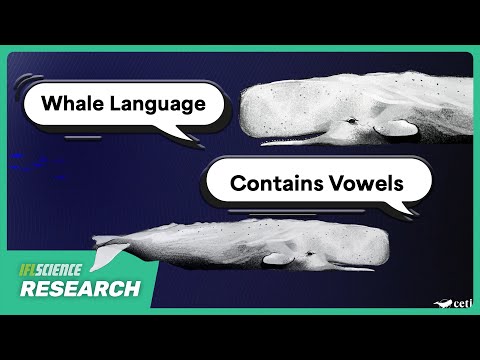
The work is based on an acoustic analysis of thousands of recordings collected off the coast of Dominica—one of the few places on the planet where sperm whales live in stable matriarchal communities and regularly engage in complex acoustic interactions.
And for the first time, it has become clear: the ocean doesn’t just make sound; it speaks.
Two Types of Sound—Like "A" and "I"
Researchers discovered that so-called sperm whale codas—rhythmic sequences of clicks—are not organized randomly.
Within them, two stable categories of signals stand out:
"a-type" sounds
"i-type" sounds
These are not literal vowels.
However, they are phonological categories—the structural level upon which human languages are built.
And even more importantly:
the duration of the clicks changes the meaning.
In other words, sperm whales use the temporal architecture of sound as a carrier of information.
Language Without Words—But Not Without Structure
Until now, it was believed that complex linguistic organization was a uniquely human trait.
Now we know:
sperm whales possess
rhythm
variations in duration
sound categories
repeatable structures
These are no longer just signals.
It is a system.
Moreover, it emerged independently of human speech—evolutionarily, we have been separated for nearly 90 million years.
The Ocean as a Space for Dialogue
Unlike the songs of humpback whales, which resemble musical forms, sperm whale codas function differently.
They sound like an exchange.
like dialogue
like responses
like coordination within the group
And that is precisely why Project CETI researchers view them as a possible foundation for a non-human language system.
Artificial Intelligence Has Begun Listening to the Ocean Differently
Machine learning methods were used for the analysis.
AI helped identify recurring patterns:
spectral structure
click duration
interval variations
sequence context
This is the first time the sperm whale acoustic system has been studied at a phonological level.
That is, at the level of linguistic structure.
Why This Discovery Matters Now
We have reached the threshold of translating non-human speech for the first time.
Not metaphorically. Scientifically. And perhaps for the first time in human history, there is a chance to understand what the ocean has to say about itself.
What has this event added to the sound of the planet?
What has this event added to the sound of the planet?
- it turns out that language can emerge in more than just humans
- it turns out that culture can exist in the depths of the ocean
And perhaps for the first time in the history of science, we are beginning to hear signs of another intelligent social system on Earth.
Humanity has long considered itself the sole voice of the planet.
It is now becoming clear—we have always lived among other speaking worlds

