


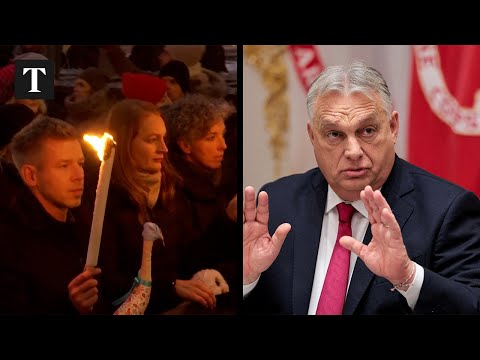
Mass Protests Erupt in Budapest Demanding Orbán's Resignation Amid Child Abuse Scandal
Edited by: Tatyana Hurynovich
On Saturday, December 13, 2025, the Hungarian capital of Budapest became the epicenter of massive demonstrations, drawing tens of thousands of citizens into the streets. The immediate catalyst for this widespread unrest was the revelation of systemic child abuse within state-run institutions, facts that began surfacing in September 2025. The situation reached a boiling point following the release of video evidence capturing a shocking incident where an employee of one such facility was seen kicking a young boy lying on the ground in the head.
Opposition leader Péter Magyar, who heads the Tisza party, spearheaded this demonstration, issuing direct calls for the immediate resignation of Prime Minister Viktor Orbán. Magyar sharply criticized the government, asserting it had failed in its fundamental duty to safeguard the nation's most vulnerable populations. In response to the escalating political crisis, government bodies took swift action: on December 10, 2025, five juvenile detention centers were placed under the direct operational control of the Ministry of Interior and the police force. Furthermore, four staff members from the center on Szőlő Street were detained as part of the ongoing investigation, alongside three other individuals, including a former director suspected of orchestrating an underground prostitution ring.
The outrage among the protesters was significantly fueled by perceived efforts from the authorities to frame the victimized teenagers as perpetrators. The opposition brought to light a 2021 government report detailing approximately 3,000 alleged instances of mistreatment involving children under state care. This figure represented more than one-fifth of all children registered in the system at that time. The report also documented that over 320 of these youths had been subjected to sexual violence. Gergely Gulyás, the Prime Minister's Chief of Staff, stated that this report was forwarded to the relevant agencies in 2022, a timeline the opposition views as deliberate concealment of the problem's true scope.
The current political tension is not without precedent, further eroding public trust in the ruling administration. Less than two years prior to these events, a major scandal led to the resignation of President Katalin Novák, a key Orbán ally. Her departure followed her decision to pardon an accomplice convicted in a high-profile child sexual abuse case at a children's home. These recurring incidents underscore deep-seated systemic vulnerabilities within the country’s child protection mechanisms.
These dramatic events are unfolding as the nation approaches the parliamentary elections scheduled for April 2026. Péter Magyar and his Tisza party have shown consistent momentum, leading in several recent opinion polls. This positions the current crisis as a substantial electoral challenge for Prime Minister Orbán, who has held office since 2010. Demonstrators marched a significant route, moving from the center of Pest, crossing the Danube River, and proceeding toward Buda Hill, chanting slogans demanding the head of government step down.
66 Views
Sources
Deutsche Welle
Al Jazeera
Reuters
Euractiv
Glas Slavonije
RTL Today
Read more articles on this topic:


Did you find an error or inaccuracy?We will consider your comments as soon as possible.