


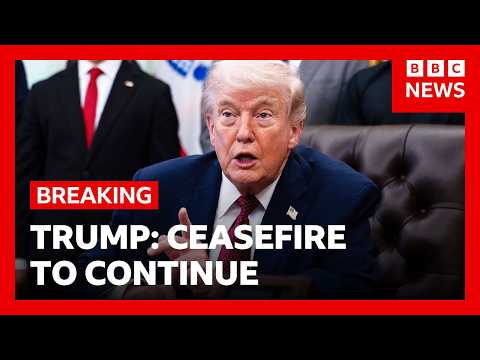
U.S. President Donald Trump has announced that the ceasefire with Iran will be extended indefinitely. This decision was reached at the request of Pakistani leadership, despite Washington's uncompromising stance on the blockade of the Strait of Hormuz.
Donald Trump indicated that the ceasefire will remain in place until Tehran proposes its own terms for peace. Posting on Truth Social, he noted that Field Marshal Asim Munir and Prime Minister Shehbaz Sharif had asked for a suspension of strikes against Iran to allow its leaders time to develop a unified proposal. The previous truce was set to expire on April 22.
Tehran rejected the extension, calling it pointless and a U.S. ploy to buy time for a renewed offensive. Mehdi Mohammadi, an advisor to the parliamentary speaker, emphasized that the losing side does not dictate terms, adding that the port blockade is tantamount to a bombing campaign and demands a military response. Foreign Minister Abbas Araghchi accused the United States of violating the truce by seizing an Iranian vessel and maintaining the blockade, declaring that Iran would protect its own interests.
Trump has ordered the military to maintain the blockade of the Strait of Hormuz and remain in a state of full readiness. He pointed out that Iran is losing approximately $500 million a day, characterizing their threats to close the strait as a way to "save face" since the U.S. has already effectively sealed it. The President refused to lift the blockade, warning that a deal to end the war is impossible without it, and threatened to strike Iranian positions.
The day before, Trump told CNBC that he was unwilling to extend the truce and was prepared to resume bombing. Pakistan had attempted to organize a second round of talks in Islamabad, but U.S. Vice President JD Vance canceled the visit. Iran had previously warned it would resume hostilities in the absence of an agreement.
Market uncertainty surrounding the conflict and the blockade of the Strait of Hormuz has seen Brent crude prices rise by $4 per barrel. The U.S. holds Iran responsible for the global oil price crisis due to its threats to close the strait, while Tehran claims the route is open to everyone except the U.S., Israel, and their allies.


