


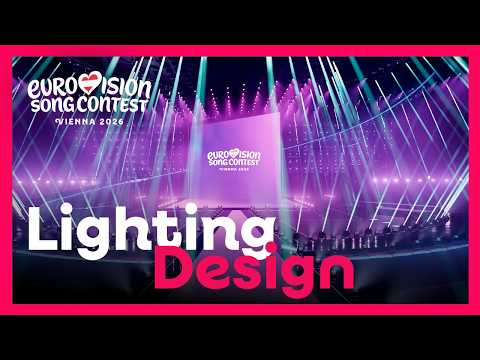
Vienna 2026: Lighting Design concept revealed for the 70th Eurovision Song Contest | #Eurovision2026
Share
Edited by: Inna Horoshkina One
Vienna 2026: Lighting Design concept revealed for the 70th Eurovision Song Contest | #Eurovision2026
In 2026, the European Broadcasting Union (EBU) will celebrate the 70th anniversary of the Eurovision Song Contest, one of the most resilient cultural projects in Europe. What began in 1956 as an experimental foray into transnational television broadcasting has gradually transformed into a unique platform for a collective European sound.

Eurovision 1956 - Lys Assia - Refrain (Audio)
The inaugural contest was held on May 24, 1956, in Lugano, Switzerland. At that time, only seven nations participated: Belgium, France, Germany, Italy, Luxembourg, the Netherlands, and Switzerland. The victory was secured by the Swiss singer Lys Assia with her performance of the song "Refrain."
Originally, the competition was modeled after the Sanremo Music Festival as both a technical and cultural experiment. The goal was to test the feasibility of live television broadcasts across European borders while simultaneously encouraging the creation of new, original songwriting. Over time, this objective has expanded, and Eurovision has become a mirror reflecting the cultural shifts within Europe.
To commemorate this milestone, the German public broadcaster ARD has produced a documentary film titled "70 Jahre ESC – More than Music." This production offers a deep dive into the history and legacy of the world's largest live music event.
The television premiere of the documentary is set for May 11, 2026, while a streaming version will be available starting May 8 on the ARD Mediathek platform. This dual release ensures that fans across different platforms can engage with the contest's storied past.
The 90-minute film traces the evolution of the contest from a television experiment to a cultural space for pan-European dialogue. The documentary features interviews with pivotal figures from various eras, including Nana Mouskouri, Conchita Wurst, Jean-Paul Gaultier, and Peter Urban.
Special attention is given to the contest's role as a platform for cultural diversity and inclusivity. The film highlights the 1998 victory of Dana International as a significant turning point in expanding public representation on the Eurovision stage.
The 70th anniversary edition of the contest will take place in Vienna, following the 2025 victory of the Austrian singer JJ with the song "Wasted Love." This win marks a triumphant return for Austria as the host nation for this historic jubilee.
The primary venue for the event will be the Wiener Stadthalle. This legendary arena will host the thousands of fans and international delegations expected to descend upon the city for the festivities.
The official schedule for the competition is as follows:
The organization of the event is a joint effort between the European Broadcasting Union and the national broadcaster ORF. Together, they aim to deliver a production that honors seven decades of musical history.
The hosts for the 2026 contest have been announced as Victoria Swarovski and Michael Ostrowski. Their presence will guide the international audience through the high-energy performances and the iconic voting sequence.
In honor of the anniversary, the first-ever official tour has also been announced: the Eurovision Song Contest Live Tour 2026. This tour will run from June 15 to July 2, bringing together artists from different generations of the contest alongside participants from the 2026 edition.
The tour will visit several major cities, including:
This marks the first time that Eurovision has expanded beyond a televised event to become a standalone touring cultural format. It offers a new way for the community to connect with the music and the performers outside of the main competition week.
However, as the jubilee year approaches, the contest also reflects a new political reality, with the number of participants dropping to 35 countries. This is the lowest number of participating nations since 2003.
The decrease is due to the decision of five broadcasters to withdraw from the competition in protest against the inclusion of Israel. This development emphasizes that Eurovision remains not only a musical stage but also a space where current pan-European discussions and tensions are mirrored.
Over seven decades, the contest has traveled a long path: from a broadcasting experiment to a laboratory for cultural dialogue, and finally to a space for a collective European voice.
In this anniversary year, the primary meaning of the event is particularly clear: music remains one of the few forms of communication through which Europe continues to hear itself as a unified whole.
PRESSEPORTAL
70 Jahre ESC – More than Music - fernsehserien
First Eurovision Song Contest winner | Guinness World Records
Eurovision Marks 70 Years with First-Ever Official Live Tour Across Europe
Eurovision song contest to go on tour to celebrate 70th anniversary
96 offizielle News zu Musical 2026 - Presseportal


