


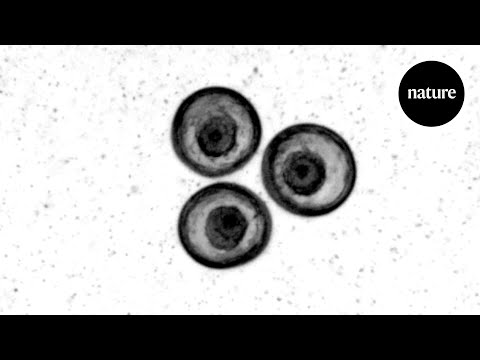
Thousands of tiny embryos are spinning — and the ocean shapes them into a perfect geometric pattern.
Share
Edited by: Inna Horoshkina One
Thousands of tiny embryos are spinning — and the ocean shapes them into a perfect geometric pattern.
Scientists have identified a remarkable phenomenon involving active matter within dense cultures of Patiria miniata starfish embryos. A research team, spearheaded by Yu-Chen Chao, observed that when these embryos reach high concentrations at the air-water interface, they spontaneously organize into structures described as living chiral crystals.
These biological formations arrange themselves into a precise hexagonal lattice, mirroring the structural integrity typically found in inorganic minerals. However, the defining characteristic here is that every individual component within the lattice remains a living, breathing organism, maintaining its biological functions while contributing to the collective whole.
This observation is particularly significant because it demonstrates that the boundary separating biology from physics is much more fluid than previously understood. It showcases how biological entities can mimic the behavior of inanimate physical systems through simple mechanical interactions.
The formation of these living crystals begins with the intrinsic movement of the embryos themselves. Each organism rotates within the fluid, generating microscopic hydrodynamic currents that influence the surrounding environment and nearby neighbors.
As the density of these organisms increases, their individual movements begin to interact with one another in complex ways. This interaction creates a collective attraction effect that pulls the embryos together into a highly organized and repeating grid.
This process results in the emergence of a new non-equilibrium phase of matter. The system remains vibrant and dynamic, with the crystals capable of transitioning between various vibrational and oscillatory states rather than remaining static like traditional crystals.
Such complex behavior is fundamentally linked to the breaking of chiral symmetry. In this context, the specific direction of rotation of individual elements dictates the overall structure and orientation of the entire collective system, leading to the chiral nature of the crystal.
These systems are classified within the specialized field of active matter research. Unlike traditional matter, active matter consists of particles that consume energy to generate their own motion and force, leading to unique physical properties.
In contrast to classical thermodynamics, where order typically emerges from a state of rest or cooling, order in these biological systems arises from continuous, vigorous activity. It is a state of organization fueled by the constant expenditure of energy.
The discovery of living chiral crystals provides direct experimental evidence for the existence of non-equilibrium phases within biological frameworks. It serves as a prime example of how life itself is capable of architecting matter into complex, functional forms.
Understanding these natural self-organization processes could have profound implications for several cutting-edge technological sectors. The ability to harness biological principles for engineering is a rapidly growing field of interest for researchers worldwide.
One potential application lies in the development of self-assembling robotic systems. In such scenarios, numerous small, autonomous units could automatically form complex structures or tools without the need for external intervention or centralized control.
Furthermore, these findings could revolutionize heat flow management in electronic devices. Engineers might design cooling systems that mimic how embryos manipulate the fluid around them to dissipate heat or transport nutrients more efficiently.
The research also paves the way for the creation of innovative active matter materials. These are systems designed to change their internal structure dynamically in response to shifting environmental conditions, much like the starfish embryos respond to their surroundings.
To facilitate the study of these phenomena, the researchers developed sophisticated cultivation techniques for Patiria miniata. These methods ensure a consistent and stable biological platform for long-term observation and experimentation.
The larvae typically reach the necessary stage for study in approximately 15 days. Meanwhile, achieving full sexual maturity within specialized flow systems takes about two years, highlighting the long-term commitment required for this biological research.
This rigorous cultivation process establishes a reliable foundation for further exploration into the mysteries of self-organization. It allows scientists to probe deeper into how individual biological units coordinate to create macroscopic order.
Ultimately, this discovery serves as a powerful reminder that order can emerge naturally from the essence of life itself. It does not require external command but rather arises from the synergy of countless small, individual movements working in concert.
It suggests that when living particles are brought together under the right conditions, the universe naturally begins to construct a crystal. This phenomenon reveals an inherent geometry in existence, where life and physics converge to create something entirely new.
Nature
Google Scholar
MIT Physics
ResearchGate
PubMed
ScienceDaily


