


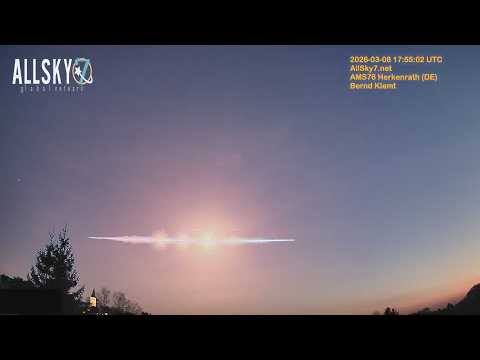
On the evening of Sunday, March 8, 2026, a spectacular celestial event illuminated the skies over Western Europe. Residents across several German federal states, as well as those in France and Switzerland, witnessed a brilliant atmospheric display that was later officially confirmed as a meteorite fall. The visibility of the event was remarkably broad, stretching from Basel in Switzerland and parts of France to the Netherlands and deep into the German interior. Almost immediately, social media platforms were flooded with a surge of amateur videos and photographs capturing the descent.
The luminous phenomenon was particularly visible to observers in Lower Saxony, Hesse, Saarland, and Baden-Württemberg, as well as across the border in Switzerland. This widespread sighting triggered a significant public response, as the sheer brightness of the object captivated onlookers. The rapid dissemination of visual evidence online allowed researchers and the general public to track the trajectory of the object in near real-time, highlighting the scale of the event across the western regions of the continent.
The incident reached a dramatic conclusion when fragments of the celestial body survived their passage through the atmosphere and struck the ground, causing property damage in the state of Rhineland-Palatinate. In the Hunsrück region, at approximately 19:00 local time, authorities recorded the impact of a "charred heavenly body" directly onto the roof of a residential building. Further north, in the Güls district of Koblenz, emergency services confirmed that a fragment had punched through a roof, leaving a hole roughly the size of a football.
Initially, the Kaiserslautern police described the sighting as a "vividly glowing object with a brief trail of fire" or a "fiery explosion in the sky," indicating the meteor's high-velocity entry into the Earth's dense atmospheric layers. Government response was swift and coordinated; following consultations with the Spangdahlem space agency and an analysis of data provided by the German Meteorological Service, officials were able to rule out any threat of an aviation disaster. While police and fire departments in the affected areas confirmed the structural damage, they emphasized that no citizens were injured and that there was no "major danger" to the public. Police in North Rhine-Westphalia also monitored the situation, though no specific damage was reported in that state.
Witnesses described the event as a blinding flash, characterized by a massive fireball dragging a long, luminous tail that often appeared in shades of orange or red. In addition to the visual spectacle, the entry was occasionally accompanied by a thunderous sonic boom. The resulting pressure wave was powerful enough to cause windows to vibrate, adding a physical intensity to the visual drama unfolding in the night sky.
This event adds to a growing list of notable meteorite falls in German history. In January 2024, a meteorite approximately one meter in diameter was discovered near Berlin and later identified as a rare aubrite. Similarly, about a year prior to the March 2026 event, approximately a dozen fragments were recovered in the state of Schleswig-Holstein, with the largest piece weighing 3.7 kilograms. These precedents illustrate that while the entry of cosmic bodies into the atmosphere is a regular occurrence, direct impacts that cause damage to man-made structures remain relatively rare and scientifically significant events.


