


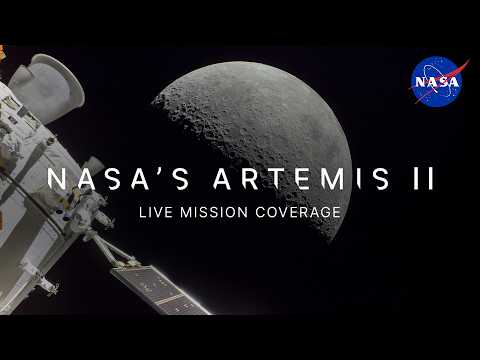
NASA live broadcast
Share
Author: Aleksandr Lytviak
NASA live broadcast
NASA has indeed returned humans to a lunar trajectory: the Artemis II mission launched on April 1, 2026, and has already left Earth orbit on its way to the Moon. This is the first crewed lunar mission since Apollo 17 in 1972, and the primary meaning of the flight lies not in symbolism, but in testing whether humanity is ready to work far beyond Earth again.
Artemis II is an approximately ten-day lunar flyby without a landing. On board Orion are Reid Wiseman, Victor Glover, Christina Koch, and Canadian Jeremy Hansen. After a key burn on April 2, the spacecraft left Earth orbit, and by April 4, according to NASA data, the crew had already covered more than half the distance to the Moon and is preparing the cabin for scientific observations during the flyby on April 6.
Why is this story more important than one spectacular historical photo? Because Artemis II tests not a slogan like “we are at the Moon again,” but an entire engineering chain: the SLS rocket, the Orion spacecraft, life support systems, communication procedures, medical preparation of the crew, and human performance in deep space. This is precisely what separates a beautiful demonstration from the real infrastructure of a new lunar era. If the system withstands ten days of autonomous flight now, NASA will have a real foundation for subsequent, more complex missions.
This mission also has an important human layer. Several “firsts” have converged on a single trajectory: the first woman, the first Black astronaut, and the first non-American in a lunar expedition of this class. But something else is even more important: Artemis II shows that the 21st-century lunar program is being built not as a race for a flag, but as a long-term project with international participation and practical calculation. What does the mere fact of human presence near the Moon change? It changes the horizon of decisions on Earth—from investments in space systems to political competition surrounding future lunar infrastructure.
The most interesting moment lies ahead—a six-hour observation period during the flyby. NASA expects the crew to see about 20% of the far side of the Moon in sunlight and be able to film areas that humans have not previously seen with the naked eye under such conditions, including the Orientale basin and a number of large craters. This is not just a beautiful episode for a broadcast: such observations simultaneously train the crew, test operational procedures, and provide material for subsequent flights.
What’s next? If the flyby and return proceed as planned, the world will receive not only a powerful symbolic moment but also a practical answer to the main question of the Artemis program: whether humans can be reliably sent beyond low Earth orbit on a regular basis. This is where the real news lies. Not “man has seen the Moon again,” but “the system is learning again to make deep-space human flight a working reality.” And perhaps, in a few years, this is exactly what will be remembered as the true beginning of a new lunar era.
nasa


