


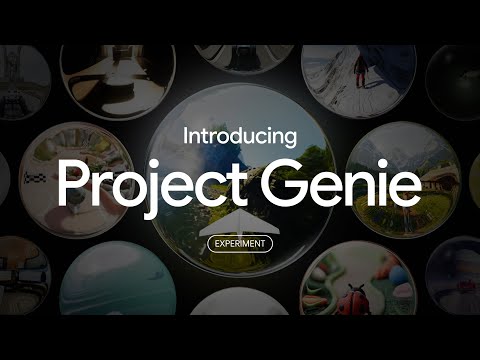
On January 29, 2026, Google DeepMind announced the opening of limited early access for Project Genie, an experimental research prototype available exclusively to Gemini Ultra subscribers in the United States. This release enables users to generate and explore dynamic environments created entirely from text prompts or reference images.

Technology: A Hybrid AI Architecture
Project Genie operates through a sophisticated integration of three distinct AI systems:
- Genie 3 (World Model): DeepMind’s foundational model that predicts the next frame of a video sequence based on user input, simulating a consistent environment with simplified physics.
- Nano Banana Pro: A Gemini-powered image model variant responsible for converting the user's initial prompt into the high-quality visual baseline required to start the simulation.
- Gemini (Orchestrator): The agent acts as the reasoning engine for interaction, managing camera perspective and character actions to ensure the navigation feels responsive to user commands.
Interactive Video-Streams & Limitations
Unlike traditional 3D game engines, Project Genie creates interactive video-stream environments. The system generates a continuous flow of frames in real-time that react to control inputs, offering a unique, dreamlike exploration experience.
During this experimental phase, the tool operates under strict technical constraints:
- Session Limit: Interactive sessions are strictly capped at 60 seconds due to the high computational intensity of real-time generation.
- Performance: Environments are rendered at 720p resolution at 24 frames per second (FPS).
- Remixing: Users can utilize a "remixing" feature to modify existing generations, altering the artistic style or environmental rules of a world that has already been created.
Strategic Context
Shlomi Fruchter, Research Director at DeepMind, noted that the prototype aims to reveal unique interactive capabilities that cannot be achieved through standard rendering methods. The primary goal of this public test is to gather extensive training data to refine how world models understand physics and spatial logic, a critical step toward developing safer embodied AI agents for robotics and complex simulations.


