


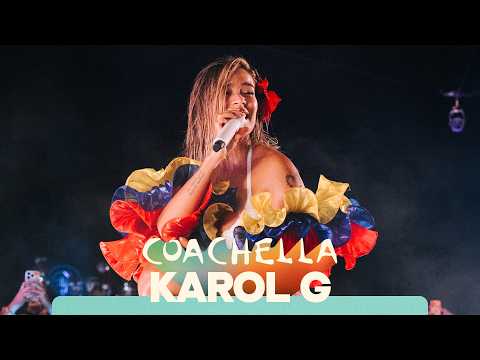
Karol G - Provenza - Live at Coachella 2026
Share
Author: Inna Horoshkina One
Karol G - Provenza - Live at Coachella 2026
On April 12, 2026, Karol G made Coachella Valley Music and Arts Festival history, becoming the first Latina artist to headline the festival and close the first weekend of its 25th-anniversary edition.
This event was more than just a standout concert moment.
It signaled a cultural shift in the landscape of the global pop scene.
The performance at the Empire Polo Club was staged as a grand spectacle of the Tropicoqueta era—Karol G’s current artistic phase, which blends various layers of Latin musical tradition.
The set featured a seamless blend of:
salsa
reggaeton
baile funk
This musical framework demonstrated that today’s Latin American scene sounds less like a regional style and more like the universal language of the global dance floor.
A series of guest appearances served as a core element of the performance, heightening the concert's cross-genre energy.
The stage featured:
Mariah Angeliq performing ‐El Makinon‐
Becky G performing ‐Mamiii‐
A standout moment was the premiere of new material featuring Greg Gonzalez, a collaboration that bridged Latin pop with an atmospheric alternative aesthetic.
During her set, Karol G specifically noted the symbolic weight of the occasion:
nearly 27 years had passed before a Latina artist headlined Coachella for the first time.
This fact underscores the magnitude of the cultural shift taking place.
Spanish has firmly established its place on the world's premier festival stage, appearing not as a guest, but as an equal voice in global pop music.
One of the concert's most moving segments was the performance of "Mi Tierra" alongside an all-female mariachi ensemble—a tribute to Gloria Estefan and the legacy of Latin music.
The gesture highlighted a defining feature of the set: it was not just a modern spectacle, but a musical bridge between generations of artists.
The festival's anniversary edition made one thing clear:
the main stage no longer belongs to a single musical tradition
a single language
or a single region
It belongs to a global audience.
That is why Karol G’s performance was not only a personal triumph for the artist but a symbol of the shifting architecture of modern pop culture.
It confirmed that Latin music is no longer simply moving toward the center of the world stage.
It is vibrating from within it. And when Spanish closes out Coachella’s first weekend, it represents more than just a change in accent; it reveals the intertwining of global musical currents. Rhythms are no longer divided by borders.
They converge. Salsa meets pop stagecraft. Reggaeton integrates into the world's festival vernacular.
Baile funk carries the southern pulse into the global dance rhythm.
Today, the global stage sounds like a space where different languages do not merely replace one another—
they begin to resonate together.


