



"La Caverne du Pont Neuf" is far more than just an art installation. It serves as a statement that art can be ephemeral, free, and open to everyone. While Plato wrote about the cave as a trap, JR constructs his cave as an exit—a space where people can gather, reflect, and step into the light together.
Decoding the Metaphor: Plato and the Modern World
In the "Allegory of the Cave" from the dialogue The Republic, Plato paints a vivid scene of prisoners chained with their backs to the entrance, seeing only shadows on a wall and mistaking them for reality. They are unaware that these shadows are merely reflections of actual objects and events occurring outside at the cave's opening. For these individuals, the world is defined entirely by flickering silhouettes. When a freed prisoner steps into the light and discovers the true nature of reality, he finds that if he returns to explain it to the others, he is met only with confusion and rejection.
This myth is far more than an ancient allegory. Today, in the view of French artist JR, we find ourselves in a similar predicament, only the "cave wall" has migrated to our smartphone screens. Social media algorithms now shape our worldview, presenting us not with reality, but with distorted, personalized "shadows."
JR interprets this as a contemporary version of Plato’s cave, where we mistake digital streams for genuine reality and lose our connection to both the physical world and one another.
JR’s Response: A Physical Cave as a Path to Liberation
The artist offers a paradoxical solution: building a literal cave in the heart of Paris to help people find their way out. From June 6 to 28, the city’s oldest bridge, the Pont Neuf, constructed in 1607, will be transformed into "La Caverne du Pont Neuf"—a monumental 120-meter immersive installation. Entry is free and open to everyone around the clock.
Time Out has hailed the project as the premier new event of 2026, while Paris Mayor Anne Hidalgo described it as a gift to the city.
The Core Concept: The Cave as an Exit
JR defines the purpose of art clearly: "The mission of art is to make people think. The conversation a monumental project sparks in a public space is just as valuable as the work itself."
"La Caverne" is not a metaphor but a tangible space to traverse, allowing visitors to enter the darkness at one end of the bridge and emerge into the light at the other alongside their fellow citizens. This is the literal embodiment of "escaping the cave":
- physical action replaces abstract thought, as you quite literally walk the path to liberation;
- shared experience stands in contrast to digital isolation, where you navigate the cave alongside strangers and share your impressions;
- the installation's ephemeral nature highlights the value of the present, reminding us that just as in life, the opportunity to step into the light exists for only a limited time.
JR’s Ideology: Art as a Tool for World Transformation
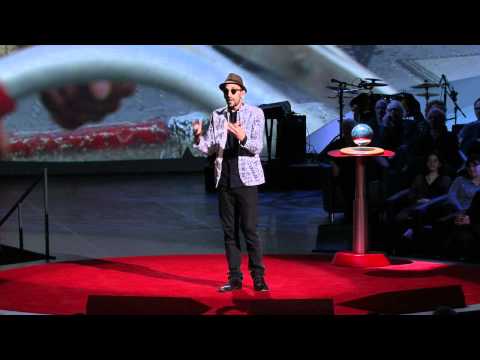
A central tenet of JR's work is his goal to "turn the world inside out through art," a concept from his 2011 TED Talk. This phrase has become a manifesto for his approach: art should not merely decorate a space, but shift perceptions, reveal hidden meanings, and unite people.
The Core Principles of JR’s Ideology:
- Art belongs in the streets. JR intentionally rejects galleries and museums, using building walls, bridges, borders, and public spaces as his canvas. The city becomes a gallery accessible to everyone.
- People are more important than the artist. The creator fundamentally refuses to disclose his surname, as the artist's name should not overshadow those he depicts. The focus remains on the stories of ordinary people.
- Publicity and accessibility. All of JR’s projects are free and open to everyone. Art should not be a privilege for the few—it belongs on the streets where everyone can see it.
- Ephemerality as a value. JR's works exist for a limited time, serving as a reminder that art is an experience rather than a collectible object.
- Dialogue is more important than monologue. The artist's projects provoke discussion, compelling people to talk to one another and see perspectives other than their own.
- Art serves as a bridge. JR creates works that connect people on different sides of barriers—whether political, social, or cultural.
- Participation instead of contemplation. Many of his projects involve active participation from the audience, who become co-creators rather than mere observers.
The Anatomy of the "Cave"
- The exterior mimics limestone, specifically the stone from Parisian quarries used to build the Pont Neuf in the 17th century, using a trompe-l'œil technique where stone surfaces are created via optical illusions on fabric.
- The interior space blends sound, light, and augmented reality accessible through a smartphone.
- The soundscape was created by Thomas Bangalter, co-founder of Daft Punk, who was inspired by seeing the Pont Neuf wrapped in gold fabric as a child—an event he says changed him forever.
Key project statistics: The 120-meter installation is the largest immersive work in history and will stand for 23 days from June 6 to 28 before being permanently dismantled; it required 800 workers, 18,900 square meters of fabric, and 20,000 cubic meters of air, and notably, it used €0 in public funds, being financed entirely through private means, including the sale of JR’s works and contributions from partners such as Bloomberg Philanthropies, Snap Inc., and Paris Aéroport.
The Story of JR: From Graffiti to Global Projects
JR is a French artist and photographer who fundamentally refuses to disclose his last name. Now 43, he was born in Paris and began his artistic journey with graffiti in the Paris Metro. A turning point came in 2001 when he found an abandoned camera on a subway train, leading him to start taking photographs and subsequently pasting giant portraits on building walls.
Key milestones in his career include:
- pasting portraits of Israelis and Palestinians face-to-face on the separation wall in Jerusalem;
- installing a massive portrait of a baby overlooking the US-Mexico border;
- co-directing the Oscar-nominated documentary "Faces Places" with Agnès Varda;
- working with inmates in a maximum-security prison in California;
- launching the "Inside Out" project in 2011 with his TED Prize, allowing over 500,000 people from 152 countries to print and display their own portraits in public spaces.
The Christo Connection: A Relay of Ephemeral Art
In 1985, Christo and Jeanne-Claude wrapped the Pont Neuf in 41,800 square meters of golden fabric. The bridge remained wrapped for two weeks, attracting three million spectators. Christo was adamant about not leaving his works behind, as ephemerality was essential to him.
JR knew Christo personally. Their last meeting took place in San Francisco in 2019. When the city council suggested an artwork to mark the 40th anniversary of "The Pont Neuf Wrapped," JR reached out to the Christo and Jeanne-Claude Foundation. The artist’s nephew, Vladimir Yavachev, is taking part in the realization of "The Cave."
Christo’s methods—ephemerality, free admission, and private funding—are fully embodied in JR’s project.


