


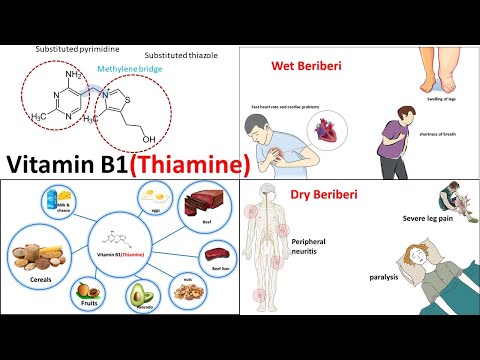
Captions: Vitamin B1 : Thiamine
Share
Author: Svetlana Velhush
Captions: Vitamin B1 : Thiamine
Vitamin B1, or thiamine, is the "unsung hero" of our metabolism. Without it, cells cannot convert food into energy, and the nervous system simply shuts down. But for decades, scientists have debated one question: how exactly does this tiny molecule perform its work inside a living cell?
In 1958, chemist Ronald Breslow proposed a "wild" idea. He suggested that for a fraction of a second, Vitamin B1 transforms into a carbene—an extremely aggressive form of carbon with "empty" bonds. The problem was that carbenes and water are mortal enemies. In an aqueous environment, a carbene should annihilate instantly before it even has a chance to react. Breslow's theory looked logical on paper but appeared biologically impossible in practice.
A team from UC Riverside has finally settled this dispute. They successfully synthesized a thiamine analogue and surrounded it with a protective framework of chlorinated carboranes. This "armor" created a dry zone around the reactive center, allowing the carbene to remain stable in water for several months. The experiment brilliantly confirmed that nature has found a way to utilize ultrapowerful chemical tools in environments where, according to the laws of classical chemistry, they cannot exist.
Why does this matter to all of us? Understanding that B1 operates through a carbene mechanism paves the way for the development of "green" chemistry. We can now use vitamin-based organic catalysts in applications that previously required toxic heavy metals.
Furthermore, it changes the approach to treating severe vitamin deficiencies and metabolic disorders. By knowing how the enzyme's "armor" protects the active site, we can design drugs that restore this protection during genetic malfunctions.
Have you ever wondered how many other "impossible" reactions are occurring in your body right now, simply because evolution learned to bypass the rules of the test tube? It seems biology is much bolder than our most daring theories.
What is the essence of Breslow's "wild" theory?
Vitamin B1 (thiamine), in the form of its coenzyme (thiamine diphosphate, TPP), participates in key metabolic reactions:
Breslow proposed that thiamine does not act merely as an "ordinary" coenzyme, but temporarily transforms into a carbene-like intermediate (Breslow intermediate). This carbene possesses high reactivity and allows enzymes to catalyze reactions that would otherwise be extremely difficult in the cell's aqueous environment.
The problem: typical carbenes react instantly with water and are destroyed. Therefore, many scientists considered Breslow's idea "wild" and impossible under biological conditions.
What was achieved in 2025?
The team synthesized a specialized container molecule (based on imidazolium) that shielded the carbene from attack by water molecules. As a result:
This is the first stable carbene in an aqueous environment in history.
Fundamentally, we finally understand the exact molecular mechanism of how Vitamin B1 works. This rewrites the biochemistry textbooks.
Practically speaking:
This is a classic example of a "wild" theory being proven correct after 67 years, thanks to progress in synthetic chemistry.
Nature Chemistry — публикация о визуализации интермедиатов тиамина.
Journal of the American Chemical Society (JACS) — исследование механизмов ферментативного катализа.
ScienceDaily — обзорный материал о «загадке Бреслоу» в современной биохимии.


