


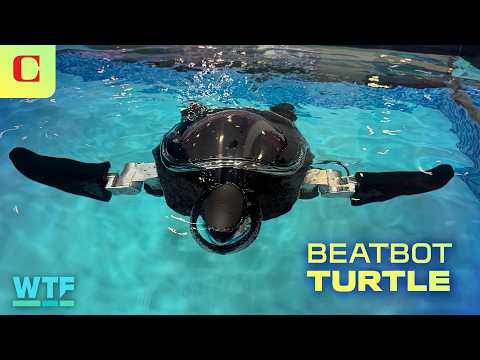
Modern engineering and oceanography are increasingly turning toward the natural world to find inspiration for the next generation of deep-sea exploration tools. One of the most fascinating developments in recent years is a sophisticated underwater robot modeled after the sea turtle, designed to swim alongside marine life and observe their natural behaviors without causing the slightest disruption to their delicate environment.
This innovative device falls under the specialized field of biomimetic robotics. In this discipline, technological solutions are meticulously crafted by studying and replicating the physical forms and movement patterns of living organisms that have evolved over millions of years to thrive in their respective habitats.
The project was brought to life by a distinguished international group of researchers representing Beihang University, also known as the Beijing University of Aeronautics and Astronautics, in collaboration with the Chinese Academy of Sciences. Their combined expertise has resulted in a platform that bridges the gap between mechanical engineering and biological efficiency.
The primary objectives for this robotic platform were clearly defined by the engineering team to ensure the device could operate effectively in sensitive zones. They sought to create a device that could move with exceptional fluidity and silence, consume significantly less energy than traditional propulsion systems, and operate safely within the fragile ecosystems of coral reefs and among various marine species.
- To move with fluid, silent motions
- To optimize energy consumption for longer missions
- To function safely within coral reefs and near marine wildlife
To achieve these goals, the robot’s physical architecture closely mirrors the biomechanics of a real sea turtle, utilizing a form factor that is both functional and non-threatening to other sea creatures. The design features include a variety of high-tech components integrated into a biological shape.
- Flexible front fins that generate a natural undulating motion for propulsion
- A streamlined, hydrodynamic hull that replicates the protective shell of a turtle
- Integrated high-definition cameras and sophisticated monitoring sensors
- A complex system for fully autonomous navigation through underwater environments
This specific method of locomotion allows the apparatus to glide through the water almost silently, which is a significant departure from the loud mechanical whirring of traditional submersibles. This acoustic stealth is a critical advantage for scientists who need to study the authentic behavior of marine animals, which are often startled or driven away by the mechanical noise of standard equipment.
During rigorous field testing, the robotic turtle demonstrated impressive operational capabilities in real-world scenarios. It proved its ability to handle complex tasks that are usually difficult for autonomous systems to manage in the unpredictable currents of the open ocean.
- Automatic navigation and obstacle avoidance
- Maintenance of a stable depth regardless of external conditions
- Precision tracking of moving biological objects
- Safe maneuvering in the immediate vicinity of fragile coral structures
According to the data released by the researchers, the autonomous system successfully avoided obstacles in approximately 91 percent of all test cases. This high success rate is considered an exceptional benchmark for autonomous underwater vehicles (AUVs) operating in unpredictable and cluttered marine environments, proving the reliability of the turtle-inspired design.
Traditional underwater exploration vehicles often rely on loud propellers and intense artificial lighting to navigate the depths. These factors can significantly alter the natural behavior of marine life, leading to skewed data and making it difficult for researchers to observe how animals truly interact with their surroundings without human interference.
Biomimetic robots effectively solve this long-standing problem in marine biology by blending into the background. By adopting a natural form and movement style, they become nearly invisible observers that the local wildlife accepts as a non-threatening presence rather than an alien intruder.
- In-depth studies of social behaviors among diverse marine species
- Continuous monitoring and health assessment of endangered coral reefs
- Broad-scale ecological research and environmental data collection
- The production of high-quality nature documentaries with unprecedented proximity to wildlife
As humanity strives to deepen its understanding of the world's oceans, we are learning that the best teachers are often the creatures that already call the sea their home. By mimicking the elegant movements of marine animals, our technology is becoming softer, quieter, and far more precise than ever before.
This evolution in design philosophy suggests that the future of oceanography lies in harmony rather than intrusion. By repeating the natural motions of aquatic life, we can gather data that was previously impossible to obtain, ensuring that our presence in the deep sea is as respectful as it is informative.
Ultimately, these bio-inspired robots represent a shift in how we approach exploration. Rather than being external observers looking in from the outside, these machines allow us to experience the underwater world as if we were a natural part of it, fostering a more harmonious relationship between technology and the environment.


