


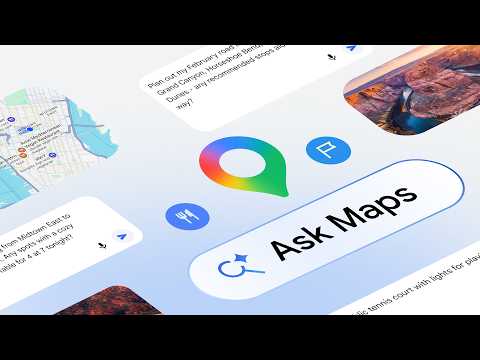
Google Maps, a service utilized by over two billion people globally, has introduced what the developer calls its "biggest navigation update in over a decade." Announced on Thursday, March 12, 2026, the transformation centers on the integration of Google's Gemini AI technology, specifically the Gemini 3 model, which manifests in two core features: 'Ask Maps' and 'Immersive Navigation.'
The conversational search tool, Ask Maps, builds upon prior conversational abilities introduced last November. It allows users to pose complex queries in natural language to obtain nuanced local information, such as identifying locations for device charging without significant wait times or generating detailed, multi-stop road trip itineraries. Gemini powers these recommendations by processing a database comprising over 300 million places and incorporating insights from more than 500 million contributors accumulated over the platform's two-decade history. For the initial launch, Google executives confirmed that sponsored content will not influence Ask Maps recommendations. The rollout for this feature is currently focused on mobile users in the U.S. and India, with a desktop version planned for a subsequent release.
Simultaneously, Immersive Navigation represents a significant revision to the turn-by-turn driving interface, providing a vivid, three-dimensional perspective of the route ahead. This spatial rendering is generated by Gemini models analyzing extensive Street View imagery and aerial photographs. The 3D visualization highlights essential road infrastructure, including lanes, crosswalks, traffic signals, and overpasses, often rendering surrounding buildings transparently to maintain focus on navigation cues. This feature also assists drivers by clearly outlining the trade-offs between alternative routes, such as comparing a faster, tolled option against a longer, toll-free route.
As drivers approach their destination, Immersive Navigation uses Street View to offer a preview of building entrances and nearby parking availability, aiming to streamline the final approach. Immersive Navigation began its rollout on mobile devices in the U.S. today, with broader availability expected across eligible iOS and Android devices in the coming months, alongside integration into CarPlay and Android Auto systems. Miriam Daniel, Vice President and General Manager for Google Maps, emphasized the robustness of the platform's AI guardrails, asserting they are sufficient to prevent the Gemini technology from fabricating erroneous information, a known issue in generative AI systems.
This technological advancement aligns with similar AI integrations across Google's product ecosystem, signaling a strategic direction toward AI-enhanced user assistance. The update positions Google Maps to evolve from a static mapping utility into a proactive, context-aware travel assistant capable of addressing complex urban navigation and detailed local discovery challenges.


