


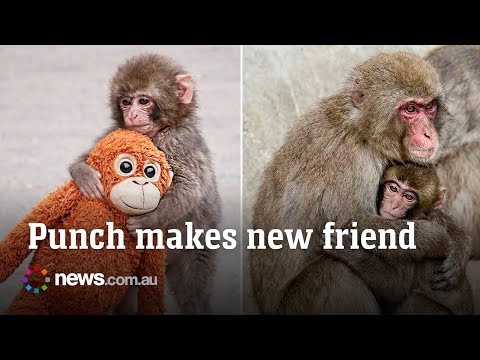
Punch, a Japanese macaque at the Ichikawa City Zoo in Chiba, Japan, has recently established a significant new social connection with Aiko, a female macaque, marking a crucial phase in his integration with the troop as of March 2026. Ethologists confirm that close physical interaction, including mutual grooming and resting, constitutes biologically fundamental activities essential for macaque group cohesion.
Punch’s unusual upbringing began in July 2025 when his biological mother rejected him shortly after birth, a rare event possibly intensified by the extreme heat at the time. Zookeepers initiated intensive assisted rearing, providing him with an IKEA orangutan plush toy, nicknamed Oran-mama, to facilitate the maternal clinging necessary for infant muscle strength and security. Keeper Kosuke Shikano noted that this intervention was vital, as infant macaques immediately cling to their mothers for essential physical and psychological support.
Following controlled feeding schedules and a period of isolation, Punch was reintroduced to the troop on January 19, 2026. Integration proved challenging, reflecting the species' complex matrilineal hierarchies where higher-ranking individuals assert dominance. In February 2026, the macaque faced disciplinary actions from an adult, which the zoo characterized as normal social interaction necessary for establishing social order through sparring and wrestling, according to primatologists.
The positive interactions with Aiko, who reportedly also experienced past rejection, signify a measurable success in Punch's social development program. Documented instances of mutual grooming and resting suggest Punch is acquiring the necessary species-typical social skills to thrive independently of the surrogate toy. Grooming specifically reinforces hierarchy, builds trust, and strengthens long-term social bonds within macaque society.
The zoo, which saw visitor numbers double in February 2026 compared to the previous year due to Punch's fame, continues to monitor his progress. Keepers are intentionally limiting visible human bonding to encourage these species-appropriate relationships, aiming for his growing independence from the plushie. These documented bonds indicate a positive trajectory toward full integration within the troop structure.


