


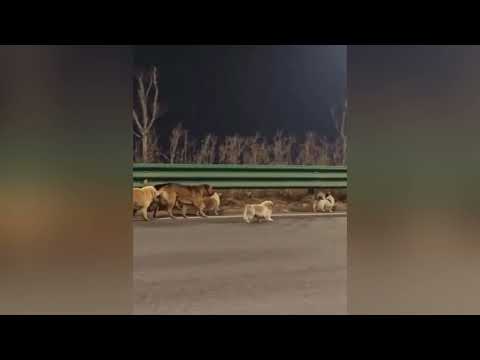
As internet users in 2026 rediscovered the sight of seven dogs marching through a snow-covered Changchun, the world once again found itself captivated by the magic of anthropomorphism. We are naturally inclined to see our finest virtues—loyalty, self-sacrifice, and discipline—reflected in the animal kingdom. But once the social media filters are removed, what truly lies at the heart of the phenomenon surrounding a corgi named Dapan?
Dapan has truly earned his reputation as the "viral general." His short legs, vigorously covering kilometer after kilometer at the head of a pack of retrievers and shepherds, provide the perfect imagery for a story about leadership against all odds. However, the real value of this story lies not in "heroism," but in its illustration of just how complex canine social hierarchies can be, even within a domestic environment.
Why are we so eager to believe that these dogs were protecting an injured companion? In an age of digital isolation, tales of mutual support within or between species act as a form of social glue. We look to nature to learn the kind of solidarity that is often missing from our lives in modern metropolises.
From a technical perspective, this incident highlights the growing potential of community-led monitoring. Even if the role of drones in this specific instance was overstated, it sets a new benchmark: by 2026, locating a lost pet in rural areas is increasingly achieved through rapid community coordination and the use of unmanned aircraft.
Looking ahead, cases like this pave the way for advancements in animal recognition systems on roadways. Such technology could reduce traffic accidents and enable volunteer networks to operate more efficiently by relying on hard data rather than just fortuitous amateur footage.
Would your perception of this "team" change if you considered that they were driven not by a code of honor, but by primal biological instincts?
Dapan and his companions serve as a reminder that even the most mundane walk can be transformed into an epic saga when viewed through a smartphone lens. It offers a vital lesson in media literacy: the ability to look beyond a "cute video" and recognize the underlying natural mechanisms and the sheer force of collective attention.


